Get up to 10% OFF! with coupon PBP10
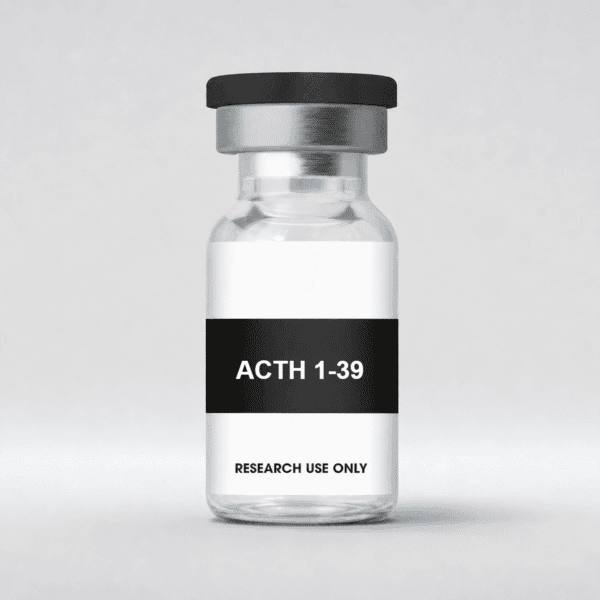
ACTH 1-39 For Sale
$66.00
10mg*10vials
Powerful ACTH 1-39 Peptide: Complete Scientific Research Guide
ACTH 1-39, also known as adrenocorticotropic hormone (ACTH) or corticotropin, is a naturally occurring 39-amino-acid peptide hormone produced from the precursor protein proopiomelanocortin (POMC). It is a central component of the hypothalamic-pituitary-adrenal (HPA) axis and is primarily associated with signaling between the pituitary gland and adrenal cortex.
For research purposes, ACTH 1-39 is particularly valuable for investigating HPA-axis regulation, adrenal steroidogenesis, melanocortin receptor signaling, cortisol biology, and POMC-derived peptide processing.
What Is ACTH 1-39?
ACTH 1-39 is the full-length 39-amino-acid form of adrenocorticotropic hormone. It is synthesized through enzymatic processing of POMC in specialized cells of the anterior pituitary.
Following its release, ACTH travels through the circulation and interacts primarily with the melanocortin-2 receptor (MC2R) on adrenal cortical cells. This interaction activates intracellular signaling pathways associated with steroid hormone production.
ACTH 1-39 is therefore an important research molecule for understanding the connection between pituitary hormone secretion and adrenal function.
ACTH 1-39 Structure and Molecular Characteristics
ACTH 1-39 is a single-chain peptide consisting of 39 amino acids. Its molecular structure is derived from POMC, a larger precursor protein that also gives rise to several other biologically active peptides.
Important characteristics researchers may evaluate include:
- 39-amino-acid sequence
- Molecular weight
- Peptide identity
- Purity
- Sequence confirmation
- Analytical characterization
- Batch information
- Formulation
- Storage requirements
The N-terminal portion of ACTH contains the primary biological activity associated with adrenal stimulation, while the complete 1-39 sequence represents the naturally occurring human ACTH molecule.
How Does ACTH 1-39 Work?
ACTH primarily produces its adrenal effects by binding to MC2R, a melanocortin receptor expressed in adrenal cortical tissue.
When ACTH interacts with MC2R, it activates intracellular signaling involving Gs proteins and cyclic AMP (cAMP). Increased cAMP activates protein kinase A and promotes signaling processes involved in adrenal steroidogenesis.
This pathway provides researchers with a well-established model for studying:
- Peptide-receptor interactions
- cAMP signaling
- Steroidogenesis
- Adrenal-cell biology
- Hormonal regulation
ACTH 1-39 and the Hypothalamic-Pituitary-Adrenal Axis
The HPA axis is one of the body’s major neuroendocrine regulatory systems.
Its basic signaling sequence is:
Hypothalamus → CRH → Pituitary → ACTH → Adrenal cortex → Cortisol
The hypothalamus releases corticotropin-releasing hormone (CRH), which stimulates ACTH production and release from the anterior pituitary.
ACTH then stimulates the adrenal cortex to produce glucocorticoids, particularly cortisol.
Cortisol participates in negative feedback regulation of the hypothalamus and pituitary, helping maintain appropriate HPA-axis activity.
This makes ACTH 1-39 an important research model for investigating endocrine feedback mechanisms.
ACTH 1-39 and MC2R Receptor Signaling
The melanocortin-2 receptor (MC2R) is also known as the ACTH receptor.
MC2R is particularly important because it is the principal melanocortin receptor responsible for ACTH-mediated adrenal steroidogenesis.
ACTH binding to MC2R initiates intracellular signaling that ultimately promotes steroid hormone synthesis.
Researchers studying this pathway may investigate:
- MC2R expression
- Ligand-receptor binding
- cAMP production
- Protein kinase A activity
- Steroidogenic enzymes
- Adrenal-cell responses
MC2R research provides important insight into how peptide hormones regulate endocrine tissues.
ACTH 1-39 and Cortisol Research
One of the most important research areas involving ACTH is cortisol biology.
ACTH stimulates adrenal cortical cells to produce glucocorticoids. Cortisol is the principal glucocorticoid in humans and participates in numerous physiological regulatory processes.
In laboratory research, ACTH can therefore be used to investigate:
- Adrenal steroidogenesis
- Cortisol production
- Steroidogenic signaling
- HPA-axis feedback
- Adrenal-cell responsiveness
Researchers should distinguish experimental ACTH-induced signaling from clinical interpretations of cortisol levels.
ACTH 1-39 and Adrenal Cortex Research
The adrenal cortex contains specialized zones responsible for producing different classes of steroid hormones.
ACTH has an especially important role in regulating zona fasciculata and zona reticularis activity.
Research involving ACTH may therefore examine:
- Adrenal-cell signaling
- Steroid biosynthesis
- Cortisol production
- Adrenal responsiveness
- Steroidogenic enzyme expression
This makes ACTH 1-39 particularly relevant to endocrine and adrenal physiology research.
ACTH 1-39 and Melanocortin Receptor Research
ACTH belongs to the broader melanocortin peptide family.
The melanocortin receptor family includes:
- MC1R
- MC2R
- MC3R
- MC4R
- MC5R
ACTH has a particularly strong relationship with MC2R, while portions of the ACTH molecule share functional characteristics with other POMC-derived melanocortins.
This makes ACTH useful for studying receptor specificity, ligand structure, and melanocortin signaling.
ACTH 1-39 and POMC Processing
ACTH is generated from proopiomelanocortin (POMC), a large precursor protein.
POMC processing differs depending on tissue type and the enzymes expressed within those tissues. This processing can generate several biologically active peptides, including:
- ACTH
- α-MSH
- β-MSH
- β-endorphin
- Related peptide fragments
Studying POMC processing helps researchers understand how one precursor molecule can produce multiple signaling peptides with different biological activities.
ACTH 1-39 and α-MSH Research
ACTH and α-melanocyte-stimulating hormone (α-MSH) are both derived from POMC and share sequence similarities.
The N-terminal region of ACTH contains the melanocortin sequence responsible for receptor interactions. However, ACTH and α-MSH are distinct peptides with different physiological contexts and receptor activity profiles.
Research comparing these molecules can help clarify:
- Peptide structure
- Receptor selectivity
- Melanocortin signaling
- POMC processing
- Adrenal versus melanocortin biology
ACTH 1-39 and Melanogenesis Research
ACTH-related melanocortin signaling has also been investigated in pigmentation and melanocyte biology.
Melanocytes express melanocortin receptors, particularly MC1R, which can influence signaling associated with melanin production.
Because ACTH contains a melanocortin receptor-binding sequence, researchers have investigated its relationship with melanogenesis and pigmentation pathways.
This represents an additional research area beyond ACTH’s classical adrenal function.
ACTH 1-39 and Endocrine Signaling
ACTH provides an established model for studying how peptide hormones communicate with cells.
The general signaling process can be summarized as:
ACTH → MC2R → G-protein activation → cAMP → protein kinase A → steroidogenesis
Studying this pathway allows researchers to investigate receptor activation, intracellular second messengers, gene regulation, and hormone synthesis.
ACTH 1-39 Research Applications
HPA-Axis Research
ACTH can be used to investigate communication between the hypothalamus, pituitary, and adrenal glands.
Adrenal Research
Researchers can examine adrenal-cell responses and steroidogenic signaling.
Cortisol Research
ACTH provides a model for studying mechanisms involved in glucocorticoid production.
MC2R Research
Researchers can investigate the structure, activation, and signaling of the ACTH receptor.
Melanocortin Research
ACTH can be studied in relation to melanocortin receptor biology and ligand interactions.
POMC Research
ACTH provides an important example of how POMC is processed into biologically active peptides.
Peptide Signaling Research
Its receptor-mediated activity makes ACTH useful for studying peptide hormone signaling and intracellular pathways.
Key Research Benefits of ACTH 1-39
Well-Characterized Hormonal Signaling Model
ACTH is one of the best-established examples of peptide-mediated endocrine signaling.
Useful for Adrenal Steroidogenesis Research
Its relationship with MC2R and cAMP signaling makes it valuable for studying adrenal steroid production.
Supports HPA-Axis Studies
ACTH provides an important component of experimental research into neuroendocrine feedback.
Valuable for Melanocortin Research
ACTH can help researchers investigate melanocortin receptor interactions and POMC-derived peptides.
Supports POMC Processing Studies
Its origin from POMC makes ACTH useful for investigating peptide precursor processing.
ACTH 1-39 vs. ACTH 1-24
ACTH 1-39 is the complete 39-amino-acid human ACTH sequence.
ACTH 1-24 contains only the N-terminal 24 amino acids.
The N-terminal region contains the primary adrenocorticotropic activity, which is why shorter ACTH fragments have also been investigated experimentally.
However, ACTH 1-39 and ACTH 1-24 are structurally different research materials and should not be treated as interchangeable.
ACTH 1-39 vs. α-MSH
ACTH and α-MSH are both derived from POMC and share related melanocortin sequences.
However, they differ in:
- Overall sequence
- Length
- Tissue context
- Receptor activity
- Biological role
- POMC processing
These differences are important when designing experiments involving melanocortin signaling.
ACTH 1-39 Purity and Quality Testing
Researchers should review available analytical documentation before evaluating an ACTH 1-39 research material.
Important quality parameters may include:
- Peptide identity
- Amino-acid sequence
- Molecular weight
- Purity
- HPLC analysis
- Mass spectrometry
- Batch or lot number
- Product specifications
- Storage conditions
Consistent analytical documentation can help improve experimental reproducibility.
ACTH 1-39 Certificate of Analysis
A Certificate of Analysis (COA) provides batch-specific quality information.
An ACTH 1-39 COA may include:
- Product identification
- Batch number
- Purity
- Molecular weight
- Analytical test results
- Testing method
- Testing date
- Product specifications
Researchers should verify that the documentation corresponds to the specific batch being evaluated.
ACTH 1-39 Storage and Handling
ACTH 1-39 is a peptide research material and should be stored and handled according to product-specific documentation.
Factors that can affect peptide stability may include:
- Temperature
- Moisture
- Light exposure
- Freeze-thaw cycles
- Formulation
- Storage duration
Laboratories should follow appropriate handling procedures and supplier specifications rather than relying solely on generic peptide-storage recommendations.
ACTH 1-39 Research Limitations
Although ACTH biology is well established, individual experimental findings should always be interpreted according to the research model.
Important considerations include:
- Differences between cell, animal, and human studies
- Differences in peptide formulation
- Receptor expression
- Experimental dose and exposure conditions
- Assay methodology
- Peptide stability
- Biological variability
A scientifically responsible research page should distinguish established biological mechanisms from findings that remain experimental.
Current Scientific Importance of ACTH 1-39
ACTH 1-39 remains an important research molecule because it connects several major areas of biology, including endocrine signaling, adrenal physiology, cortisol regulation, melanocortin receptors, and POMC processing.
Its well-characterized interaction with MC2R provides researchers with a useful model for studying how peptide hormones activate intracellular signaling pathways and regulate steroidogenesis.
ACTH 1-39 Peptide for Sale – High Purity Research Compound USA
If you are searching for ACTH 1-39 peptide for sale, sourcing from a verified manufacturer is essential to ensure purity, consistency, and reliable research outcomes. We supply high-quality research compounds for endocrinology studies, adrenal function research, and hormone signaling pathway analysis.
We follow strict laboratory guidelines.
We use analytical testing to confirm purity.
For each production batch, we offer comprehensive documentation.
The whole natural version of adrenocorticotropic hormone, a 39-amino acid peptide that controls adrenal cortex activity, is called ACTH 1-39 (Adrenocorticotropic Hormone 1-39). It is frequently used in studies on endocrine control, corticosteroid synthesis, receptor signaling, and the function of the hypothalamic-pituitary-adrenal (HPA) axis.
What You Receive
- ≥98% purity (HPLC verified)
- Analytical validation (HPLC + Mass Spectrometry)
- Certificate of Analysis (COA) available per batch
- Laboratory-secured packaging
- Available in small batch or bulk wholesale quantities
Direct manufacturer sourcing ensures product integrity, traceability, and consistent long-term supply.
Bulk ACTH 1-39 Supply
We support:
- Biotechnology research laboratories
- Pharmaceutical R&D organizations
- Academic research institutions
- Contract research organizations (CROs)
- Endocrinology and hormone research centers
- International distributors
Why Choose Premium Bio Peptides?
Premium Bio Peptides provides research-focused educational information covering peptides, research compounds, molecular mechanisms, quality documentation, and scientific topics.
Our goal is to make peptide research information easier to understand through detailed educational guides, product information, Certificates of Analysis, and related research resources.
Researchers should independently review relevant scientific literature and product-specific documentation when evaluating research materials.
Frequently Asked Questions About ACTH 1-39
What Is ACTH 1-39?
ACTH 1-39 is the complete 39-amino-acid form of adrenocorticotropic hormone.
What Is ACTH 1-39 Studied For?
Research commonly examines ACTH 1-39 in HPA-axis biology, adrenal signaling, cortisol research, MC2R activity, melanocortin signaling, and POMC processing.
What Receptor Does ACTH Activate?
ACTH primarily activates melanocortin-2 receptor (MC2R) in adrenal tissue.
What Is the HPA Axis?
The HPA axis is the neuroendocrine pathway connecting the hypothalamus, pituitary gland, and adrenal cortex.
What Is the Relationship Between ACTH and Cortisol?
ACTH stimulates adrenal cortical signaling that promotes cortisol production.
Is ACTH 1-39 a Peptide?
Yes. ACTH 1-39 is a 39-amino-acid peptide hormone.
What Is the Difference Between ACTH 1-39 and ACTH 1-24?
ACTH 1-39 is the full-length sequence, whereas ACTH 1-24 contains only the first 24 amino acids.
What Should Researchers Check on an ACTH 1-39 COA?
Researchers should review identity, sequence, purity, molecular weight, analytical testing, batch information, and product specifications.
Is ACTH 1-39 available in bulk quantities?
Yes. We provide scalable manufacturing with volume-based pricing.
Do you provide Certificates of Analysis?
Yes. Each batch includes verifiable COA documentation.
Do you ship within the USA?
Yes. Orders are fulfilled through our U.S. distribution channel.
What purity level is provided?
≥98% purity verified via HPLC (custom specifications available upon request).
Important Research-Use Statement
The information provided on this page is for scientific and educational purposes only. It is not medical advice and should not be interpreted as a recommendation for human or veterinary use.
Researchers are responsible for following applicable laws, regulations, laboratory procedures, safety requirements, and product-specific documentation.
Research materials are not intended for human or veterinary use, diagnosis, treatment, or prevention of disease.
| Dosage | 10mg*10vials |
|---|
Related products
-

Dermorphin
$82.00 -
Cagrilintide
Price range: $99.00 through $148.00Select options This product has multiple variants. The options may be chosen on the product page -
GHK-CU
Price range: $46.00 through $48.00Select options This product has multiple variants. The options may be chosen on the product page -
Hexarelin Acetate Peptide
Price range: $58.00 through $89.00Select options This product has multiple variants. The options may be chosen on the product page

Reviews
There are no reviews yet.