Get up to 10% OFF! with coupon PBP10

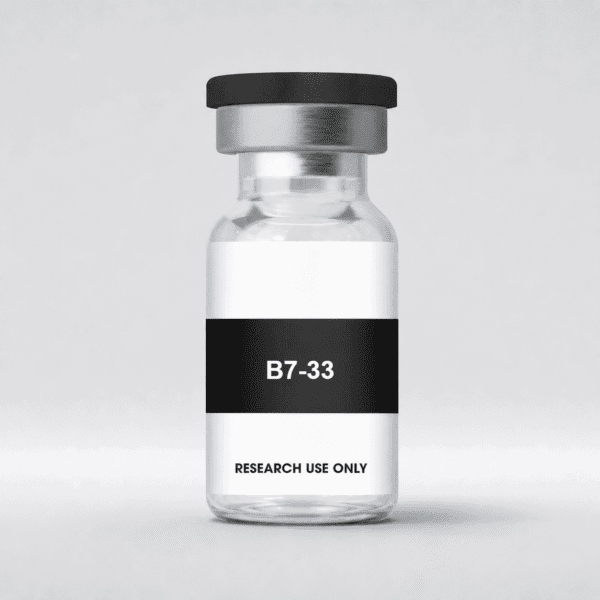
B7-33 Peptide
Price range: $64.00 through $144.00
B7-33 Peptide – Powerful Research Overview and Scientific Guide
What Is B7-33 Peptide?
B7-33 is a synthetic peptide derived from a specific region of the B-chain of human relaxin-2. It has attracted scientific interest as a research tool for investigating relaxin-related signaling, receptor biology, fibrosis-associated mechanisms, extracellular-matrix regulation, and tissue remodeling.
Unlike full-length relaxin-2, B7-33 represents a smaller portion of the parent molecule. This makes it particularly useful for researchers interested in understanding how individual peptide regions contribute to receptor interaction and downstream biological signaling.
Research involving B7-33 is predominantly laboratory and preclinical. Consequently, experimental observations should be distinguished from established clinical effects, and the compound should not be presented as an approved treatment.
B7-33 Peptide Origin and Relationship to Relaxin-2
Relaxin-2 is a naturally occurring peptide hormone that participates in several biological signaling processes. Its structure contains A- and B-chain components connected through disulfide bonds.
B7-33 was developed from the B-chain of relaxin-2. Studying this smaller sequence allows researchers to investigate selected aspects of relaxin biology without using the complete hormone.
This relationship is important for structure-function research because scientists can examine whether particular regions of a larger peptide contribute to receptor recognition, signaling, cellular responses, or tissue-related mechanisms.
B7-33 Molecular Structure and Characteristics
The molecular structure of B7-33 is based on a defined sequence derived from the relaxin-2 B-chain. As a synthetic research peptide, its characteristics can be evaluated using analytical techniques designed to confirm molecular identity and composition.
Depending on the research objective, scientists may evaluate:
- Amino-acid sequence
- Molecular mass
- Peptide purity
- Identity confirmation
- Structural characteristics
- Stability under experimental conditions
- Degradation behavior
- Receptor-associated activity
Understanding these characteristics is essential when interpreting experimental results because peptide identity, purity, and stability can influence laboratory observations.
How B7-33 Interacts With RXFP1
One of the primary scientific interests in B7-33 research is its relationship with RXFP1, a receptor associated with relaxin signaling.
RXFP1 belongs to the G-protein-coupled receptor family and participates in complex cellular signaling. Researchers investigate B7-33 to better understand how a relaxin-derived peptide sequence can interact with this receptor system.
The interaction between a peptide and receptor can initiate downstream molecular events. The resulting response may depend on the cell type, receptor expression, experimental concentration, exposure period, and other laboratory conditions.
For this reason, B7-33 research is valuable for studying receptor biology rather than assuming that a response observed in one experimental system will occur identically in another.
B7-33 Cellular Signaling Mechanisms
Cellular signaling describes the processes through which cells detect molecular signals and translate them into biological responses.
Research involving B7-33 can examine signaling events associated with RXFP1 and related pathways. Scientists may investigate changes in intracellular messengers, protein activity, gene expression, cellular behavior, and extracellular-matrix processes.
This research helps clarify the molecular relationship between relaxin-derived peptides and cellular function.
Understanding these mechanisms can also help researchers determine which biological effects are directly associated with receptor signaling and which may result from secondary cellular responses.
B7-33 and Fibrosis Research
Fibrosis is a biological process involving excessive accumulation or remodeling of extracellular-matrix components such as collagen. Abnormal fibrotic activity can alter the structure of tissues.
B7-33 has generated interest in experimental fibrosis research because relaxin-related signaling has been investigated in connection with extracellular-matrix regulation and tissue remodeling.
Researchers may use cellular and preclinical models to examine how B7-33-associated signaling affects processes involved in fibrotic responses.
These studies are intended to clarify biological mechanisms. They do not establish B7-33 as an approved therapy for fibrosis.
B7-33 and Fibroblast Activity
Fibroblasts are important connective-tissue cells responsible for producing and organizing extracellular-matrix components.
During normal tissue maintenance and repair, fibroblasts contribute to structural support. Changes in fibroblast activity can also play an important role in abnormal tissue remodeling.
B7-33 research can therefore involve experimental fibroblast models in which investigators evaluate cellular signaling, matrix-associated processes, proliferation, activation, and other measurable responses.
Studying these cellular mechanisms can provide insight into how relaxin-derived peptides may influence tissue-level processes.
B7-33 and Extracellular Matrix Research
The extracellular matrix is a complex network of proteins and other molecules surrounding cells. It provides structural support while also participating in cellular communication.
Researchers studying B7-33 may examine how relaxin-related signaling influences extracellular-matrix processes. Areas of investigation can include collagen-associated pathways, matrix production, cellular adhesion, remodeling, and fibroblast responses.
This makes B7-33 relevant to broader research into connective-tissue biology and mechanisms underlying tissue remodeling.
B7-33 in Pulmonary Research
Pulmonary research involving relaxin-related pathways has examined mechanisms associated with lung tissue remodeling and fibrosis.
B7-33 provides researchers with a peptide-based model for investigating these pathways in controlled experimental systems. Studies can examine cellular signaling, fibroblast behavior, extracellular-matrix activity, and other processes relevant to pulmonary tissue biology.
Findings from laboratory models can help generate hypotheses for future research, but they should not be interpreted as evidence that B7-33 is an established treatment for pulmonary disease.
B7-33 in Cardiovascular Research
Relaxin signaling has also been studied in cardiovascular biology. Research areas include vascular signaling, extracellular-matrix regulation, tissue remodeling, and cellular communication.
Because B7-33 is derived from relaxin-2, investigators have examined its relevance to relaxin-associated cardiovascular mechanisms.
Experimental research can help determine how specific relaxin-derived sequences influence receptor-associated signaling and cellular responses in cardiovascular models.
B7-33 and Tissue Remodeling Studies
Tissue remodeling involves changes to the structure and composition of tissues. It can occur during normal repair and development but can also become dysregulated in disease-associated processes.
B7-33 is of interest because relaxin-related signaling has been investigated in connective-tissue regulation and extracellular-matrix remodeling.
By studying B7-33 in controlled models, researchers can investigate how peptide-receptor interactions influence cellular behavior and matrix-related processes.
B7-33 Structure-Activity Research
Structure-activity research examines the relationship between a molecule’s structure and its biological activity.
For peptides, relatively small structural changes can influence receptor interaction, stability, selectivity, and cellular responses.
B7-33 provides a useful framework for investigating these relationships because it represents a defined portion of the relaxin-2 B-chain. Researchers can study how the peptide’s molecular characteristics relate to its observed activity in different experimental systems.
B7-33 Stability and Degradation Research
Peptide stability is an important consideration in laboratory research. A peptide can undergo degradation depending on environmental and biological conditions.
Researchers may investigate this research molecule stability under different temperatures, pH conditions, solvent environments, and biological matrices.
Enzymatic degradation can also affect peptide availability during experiments. Understanding these factors helps researchers design appropriate experimental protocols and interpret biological activity more accurately.
B7-33 Peptide Modification Research
Peptide modification is an established area of scientific investigation. Researchers may modify peptide structures to study how chemical or structural changes affect stability, receptor interaction, degradation, or experimental activity.
Modified B7-33 analogues can therefore be useful for structure-function studies.
The purpose of these investigations is to determine which molecular features are important for maintaining or changing specific experimental properties.
B7-33 Research Applications
B7-33 can be relevant to several areas of laboratory science.
Receptor biology: Researchers can investigate interactions involving RXFP1 and relaxin-related signaling.
Cell biology: Experimental systems can be used to study cellular responses to peptide signaling.
Fibrosis research: Scientists can examine mechanisms associated with fibroblast activity and extracellular-matrix regulation.
Molecular pharmacology: B7-33 can be investigated to better understand peptide-receptor interactions and signaling mechanisms.
Tissue remodeling: Researchers can study pathways associated with changes in connective-tissue structure.
Peptide science: The molecule can serve as a model for studying peptide structure, stability, modification, and biological activity.
B7-33 vs. Full-Length Relaxin-2
B7-33 and full-length relaxin-2 are related but structurally different molecules.
Full-length relaxin-2 contains both A- and B-chain components and represents the complete naturally occurring peptide hormone.
This research molecule is a smaller synthetic sequence derived from the B-chain. This difference makes it useful for studying specific structural components of relaxin biology.
Comparing B7-33 with relaxin-2 can help researchers understand which molecular regions contribute to particular receptor interactions and signaling responses.
How Researchers Evaluate B7-33
Scientific evaluation of a research peptide generally involves more than observing a single biological response.
Researchers may begin with analytical characterization to confirm identity and purity. Cell-based assays can then be used to investigate receptor-associated activity and cellular responses.
Additional molecular techniques may examine changes in signaling pathways, gene expression, protein activity, or extracellular-matrix markers.
Where scientifically appropriate, preclinical models may provide additional information about biological activity and pharmacological characteristics.
Using several complementary approaches provides a more reliable understanding of the compound than relying on one experimental measurement.
B7-33 Purity and Analytical Testing
Analytical characterization is important for reproducible peptide research.
Researchers may use techniques such as high-performance liquid chromatography and mass spectrometry to evaluate peptide purity and confirm molecular characteristics.
Purity is particularly important when interpreting biological experiments because impurities, degradation products, or incorrect peptide identity can potentially affect experimental outcomes.
For research applications, investigators should consider appropriate analytical documentation alongside experimental data.
Understanding a B7-33 Certificate of Analysis
A Certificate of Analysis, commonly called a COA, provides batch-specific analytical information about a research compound when supplied by the manufacturer or testing laboratory.
Depending on the laboratory and product, a COA may include information such as:
- Product identification
- Batch or lot number
- Purity results
- Testing method
- Molecular characterization
- Test date
- Laboratory information
A COA should be considered supporting analytical documentation rather than proof of clinical safety or effectiveness.
Current B7-33 Research and Future Directions
Research surrounding B7-33 continues to examine relaxin-related receptor signaling, fibrosis-associated mechanisms, fibroblast biology, extracellular-matrix regulation, tissue remodeling, and peptide modification.
Future laboratory studies may provide additional information about receptor selectivity, molecular signaling, peptide stability, structure-activity relationships, and experimental pharmacology.
Continued research is important because findings can differ between cell types, experimental systems, concentrations, and biological models.
Limitations of B7-33 Research
this research molecule has important limitations that should be considered when evaluating scientific claims.
Much of the available evidence comes from laboratory and preclinical studies. Results obtained in isolated cells or animal models cannot automatically be translated into human outcomes.
Experimental conditions can also vary significantly. Differences in cell type, receptor expression, peptide concentration, exposure time, assay design, and analytical methodology can influence results.
For these reasons, B7-33 should be described using evidence-based language and should not be promoted using unsupported medical or therapeutic claims.
Is B7-33 FDA Approved?
This research molecule should not be described as an FDA-approved medication. It is an experimental research peptide and does not have the same regulatory status as an approved pharmaceutical product.
Scientific discussions should clearly distinguish experimental research findings from regulatory approval and established clinical use.
Is B7-33 Intended for Human Use?
B7-33 discussed for laboratory research should be treated as an experimental research compound. It should not be marketed or described as a medication, dietary supplement, or treatment.
Researchers should follow applicable laboratory procedures, institutional requirements, and relevant regulations when handling research compounds.
Potential Research Benefits of This Research Molecule
- RXFP1 signaling research — B7-33 provides a useful model for investigating signaling associated with the relaxin receptor RXFP1.
- Fibrosis research — Experimental studies have examined B7-33 in pathways associated with fibrotic processes and extracellular-matrix regulation.
- Antifibrotic mechanism research — Researchers have investigated whether B7-33-related signaling can influence cellular mechanisms involved in fibrosis.
- Fibroblast research — B7-33 can be studied in experimental models examining fibroblast activity and tissue remodeling.
- Extracellular matrix research — The peptide is relevant to studies of collagen-associated processes and extracellular-matrix regulation.
- Tissue remodeling research — Relaxin-derived signaling makes B7-33 useful for investigating mechanisms involved in structural tissue changes.
- Cellular signaling research — Researchers can use B7-33 to study receptor-mediated intracellular signaling pathways.
- Cardiovascular research — B7-33 has been investigated in experimental research related to relaxin signaling and cardiovascular biology.
- Pulmonary research — Experimental models have explored relaxin-related mechanisms relevant to lung tissue and fibrosis research.
- Structure-function studies — Its smaller structure allows scientists to investigate how specific regions of relaxin contribute to receptor activity.
- Peptide modification research — B7-33 analogues can be studied to understand how molecular modifications affect stability and biological activity.
- Molecular pharmacology research — B7-33 offers an experimental tool for studying peptide-receptor interactions and related pharmacological mechanisms.
Final Thoughts on B7-33 Research
B7-33 is an experimentally studied relaxin-derived peptide with research relevance across RXFP1 receptor biology, cellular signaling, fibrosis, fibroblast activity, extracellular-matrix regulation, tissue remodeling, peptide stability, and molecular pharmacology.
Its defined peptide structure provides researchers with an opportunity to investigate specific aspects of relaxin biology and explore relationships between molecular structure and biological activity.
The existing research provides a foundation for continued investigation, but much of the evidence remains laboratory or preclinical. A scientifically responsible B7-33 resource should therefore distinguish experimental observations from established clinical evidence and avoid unsupported therapeutic claims.
Research-Use Statement: The information on this research molecule is provided for scientific and educational research purposes. B7-33 should not be represented as an approved medication or as a recommendation for human or veterinary use.
What You Receive
- ≥98% purity (HPLC verified)
- Analytical validation (HPLC + Mass Spectrometry)
- Certificate of Analysis (COA) available per batch
- Laboratory-secured packaging
- Available in small batch or bulk wholesale quantities
Direct manufacturer sourcing ensures product integrity, traceability, and consistent long-term supply.
Bulk B7-33 Peptide Supply
We support:
- Biotechnology research laboratories
- Pharmaceutical R&D organizations
- Academic research institutions
- Contract research organizations (CROs)
- Cardiovascular and fibrosis research centers
- International distributors
B7-33 Peptide FAQs
What is B7-33 peptide?
B7-33 is a synthetic peptide derived from the B-chain of human relaxin-2. It has been studied as an experimental tool for investigating relaxin-related receptor signaling, fibrosis, extracellular-matrix biology, and tissue remodeling.
What is B7-33 used for in research?
Research involving B7-33 has focused on RXFP1 signaling, fibroblast activity, fibrosis-associated pathways, cellular signaling, extracellular-matrix regulation, and tissue remodeling.
How does B7-33 work?
B7-33 has been investigated in relation to the relaxin receptor RXFP1. Researchers use experimental models to examine how this interaction may influence downstream cellular signaling.
What are the potential research benefits of B7-33?
Potential research applications include studying RXFP1 signaling, fibrosis mechanisms, fibroblast biology, extracellular-matrix regulation, tissue remodeling, and peptide structure-function relationships.
Is B7-33 related to relaxin-2?
Yes. B7-33 is derived from a region of the B-chain of human relaxin-2, but it is structurally different from the complete relaxin-2 molecule.
What receptor does B7-33 interact with?
B7-33 has been studied primarily in connection with RXFP1, a receptor associated with relaxin signaling.
Is B7-33 the same as relaxin-2?
No. B7-33 is a smaller synthetic peptide derived from relaxin-2’s B-chain, whereas relaxin-2 is a naturally occurring peptide hormone with a more complex structure.
Has B7-33 been studied for fibrosis?
Yes. Preclinical research has investigated B7-33 and related relaxin signaling in experimental models involving fibrosis and extracellular-matrix processes.
Does B7-33 have antifibrotic effects?
Experimental research has investigated potentially antifibrotic mechanisms associated with B7-33. However, laboratory findings should not be interpreted as evidence that B7-33 is an established treatment for fibrosis.
Is B7-33 FDA approved?
No. B7-33 is an experimental research compound and should not be presented as an FDA-approved medication.
Is B7-33 approved for human use?
B7-33 is not an established approved human therapy. Research material should be used only within appropriate laboratory and regulatory frameworks.
What areas of science are studying B7-33?
Research areas include molecular pharmacology, receptor biology, fibrosis research, cardiovascular biology, pulmonary research, fibroblast biology, extracellular-matrix research, and tissue remodeling.
Why is B7-33 interesting to researchers?
Its relatively small relaxin-derived structure allows scientists to investigate specific aspects of relaxin biology and examine relationships between peptide structure, receptor activity, and cellular signaling.
How is B7-33 research evaluated?
Researchers may evaluate peptide identity, purity, molecular characteristics, receptor activity, cellular responses, stability, and biological activity using appropriate analytical and experimental methods.
Is B7-33 safe?
There is not enough clinical evidence to establish B7-33 as safe or effective for human use. Safety conclusions should not be inferred from laboratory or preclinical findings.
Where can I learn more about B7-33 research?
Peer-reviewed scientific publications, reputable scientific databases, analytical documentation, and research literature are appropriate sources for learning more about B7-33 and relaxin-related signaling.
Can B7-33 be used as a medical treatment?
This page should not present B7-33 as a medical treatment. It is discussed as an experimental compound for laboratory and scientific research purposes only.
Is B7-33 available in bulk quantities?
Yes. We provide scalable manufacturing with volume-based pricing.
Do you provide Certificates of Analysis?
Yes. Each batch includes verifiable COA documentation.
Do you ship within the USA?
Yes. Orders are fulfilled through our U.S. distribution channel.
What purity level is provided?
≥98% purity verified via HPLC (custom specifications available upon request).
Why Professional Buyers Choose Us
- Transparent manufacturing processes
- Verified analytical testing
- Consistent batch-to-batch quality
- Competitive wholesale pricing
- Reliable U.S. and international fulfillment
We combine advanced peptide synthesis capabilities with a global distribution network, ensuring dependable research-grade supply for scientific and pharmaceutical research applications.
| Dosage | 5mg*10vials, 10mg*10vials |
|---|
Related products
-

TB500 (Thymosin B4 Acetate)
Price range: $58.00 through $113.00Select options This product has multiple variants. The options may be chosen on the product page -
Glutathione
Price range: $44.00 through $87.00Select options This product has multiple variants. The options may be chosen on the product page -
VIP
Price range: $73.00 through $103.00Select options This product has multiple variants. The options may be chosen on the product page -
Thymosin Alpha-1
Price range: $85.00 through $118.00Select options This product has multiple variants. The options may be chosen on the product page



Reviews
There are no reviews yet.