Get up to 10% OFF! with coupon PBP10

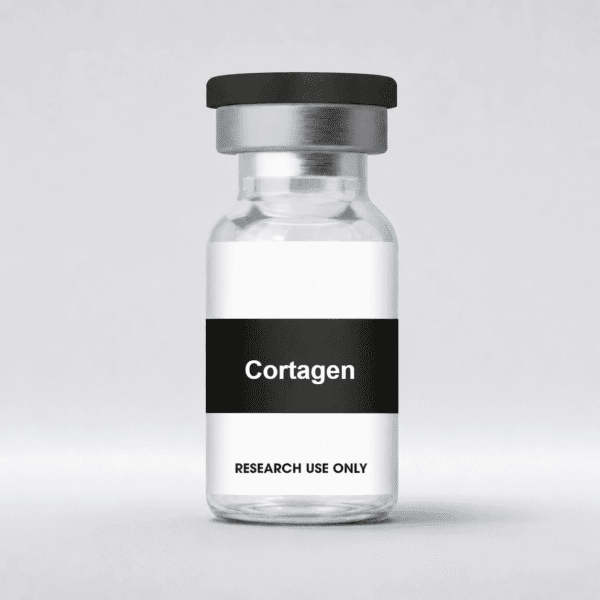
Buy Cortagen Peptide
$87.00
20mg*10vials
Cortagen Peptide – Powerful Research Guide and Scientific Overview
What Is Cortagen Peptide?
Cortagen is a synthetic tetrapeptide commonly identified by the amino-acid sequence Ala-Glu-Asp-Pro (AEDP). It was developed through directed synthesis based on amino-acid analysis of Cortexin, a peptide preparation associated with cerebral cortex tissue.
The compound has attracted scientific interest because researchers have investigated its potential relationship with brain-cortex biology, peripheral nerve regeneration, cellular regulation, gene expression, and tissue-specific peptide activity.
Much of the published work is experimental. Studies have included animal models, organotypic tissue cultures, and molecular investigations. Therefore, findings from these models should be regarded as research observations rather than established evidence of clinical effectiveness.
Cortagen Origin and Relationship to Cortexin
According to the published literature, the sequence was developed through analysis of Cortexin and subsequent chemical synthesis. This approach was intended to identify short peptide sequences that could be investigated individually rather than studying a complex mixture of naturally derived peptides.
This distinction is important: Cortagen and Cortexin are not the same substance. Cortagen refers to a defined synthetic tetrapeptide, whereas Cortexin refers to a broader peptide preparation.
Cortagen Molecular Structure and Characteristics
The commonly reported sequence is:
Ala-Glu-Asp-Pro (AEDP)
This four-amino-acid structure makes Cortagen Peptide considerably smaller than conventional protein molecules. Its short sequence also makes it useful for investigating relationships between peptide structure and biological activity.
For laboratory research, characterization may involve:
- Peptide identity
- Amino-acid sequence
- Molecular mass
- Purity
- Chromatographic profile
- Structural integrity
- Stability under experimental conditions
One commonly reported molecular weight for the compound is approximately 430.4 Da. Researchers should verify molecular characteristics against appropriate analytical documentation for the specific research material.
How Cortagen Is Studied in Research
Experimental investigations have used several different approaches to study this molecule.
Researchers can investigate its activity using cell cultures, organotypic tissue models, animal studies, gene-expression analysis, and molecular assays.
One early study examined tissue-specific effects using organotypic cultures from rat brain cortex and other tissues. Cortagen was reported to stimulate growth of brain-cortex explants in that experimental system.
Other research has examined changes in gene expression after exposure to the peptide. A 2004 microarray study analyzed 15,247 transcripts in mouse heart tissue and reported significant expression changes corresponding to 110 known genes.
Cortagen Peptide and Brain Cortex Research
Brain-cortex research is central to the proposed biological identity of this compound.
Experimental studies have investigated whether short peptides associated with cerebral-cortex tissue can influence cellular behavior in corresponding tissue models.
An organotypic-culture study reported tissue-specific effects, with Cortagen Peptide associated with growth of rat brain-cortex explants.
These findings are useful for generating hypotheses about tissue-associated peptide signaling, but they do not by themselves establish a therapeutic effect in humans.
Cortagen Peptide and Neuronal Research
Neuronal research examines the behavior, development, maintenance, and signaling of nerve cells.
Cortagen Peptide has been investigated within this broader field because of its association with brain-cortex tissue and experimental nerve-related models.
Researchers may examine cellular growth, tissue organization, signaling markers, gene expression, and other endpoints to determine whether exposure to the peptide produces measurable biological changes.
The existing evidence should be interpreted cautiously because much of the work is based on experimental models rather than controlled human clinical studies.
Cortagen and Nerve Regeneration Research
Peripheral nerve regeneration is one of the most frequently discussed areas of research surrounding Cortagen.
A 2000 experimental study investigated the tetrapeptide in a rat sciatic-nerve injury model. The researchers reported increased regeneration rate and nerve-conduction velocity following treatment in that animal model.
These results provide a reason for continued scientific interest in the compound’s potential relationship with nerve-repair mechanisms.
However, animal nerve-regeneration findings should not be interpreted as proof that the compound produces the same effect in humans. Additional independent research would be necessary to establish reproducibility, mechanism, safety, and clinical relevance.
Cortagen and Gene Expression Studies
Gene-expression research is another important area of investigation.
In a 2004 study, researchers used cDNA microarrays to examine 15,247 transcripts in the hearts of female mice following a five-day experimental course. They reported significant changes involving 234 clones corresponding to 110 known genes.
The findings suggest that exposure to the peptide was associated with measurable changes in gene-expression patterns in that experimental model.
Importantly, the study examined mouse heart tissue, not human brain tissue. Therefore, the results should not be generalized beyond the experimental conditions in which they were observed.
Cortagen and Cellular Signaling
Cellular signaling involves the molecular processes through which cells respond to external and internal signals.
The proposed research model for short peptide bioregulators includes possible interactions with cellular and nuclear components that could influence gene regulation. However, the precise mechanism of action for Cortagen has not been definitively established.
Research involving this molecule can therefore help investigate whether observed biological changes are associated with specific signaling pathways, gene-expression alterations, or broader cellular responses.
Cortagen and Neuroprotection Research
Neuroprotection research examines mechanisms that may help preserve neuronal structure and function under conditions of cellular stress or injury.
Cortagen has been investigated in research involving nervous tissue and experimental models of neural injury. Some literature has proposed neuroprotective or tissue-supporting mechanisms, but the strength of evidence varies considerably between models.
For an evidence-based research resource, these observations are best described as experimental findings under investigation, rather than established neuroprotective effects in humans.
Cortagen Peptide and Oxidative Stress Research
Oxidative stress occurs when the balance between reactive molecules and antioxidant defenses becomes disrupted.
Research involving peptide bioregulators has examined markers related to oxidative balance and cellular stress. Cortagen has consequently attracted interest in experimental research exploring whether short peptides can influence molecular pathways associated with cellular stress.
More independent research is required to establish the consistency and biological significance of these findings.
Cortagen and Tissue-Specific Peptide Research
One of the distinctive concepts surrounding Cortagen is tissue-specific peptide research.
In an early study, researchers investigated several synthetic peptides associated with different tissue preparations. Cortagen was associated with growth of rat brain-cortex explants, while other peptides were associated with other tissue types.
This work provided a foundation for the hypothesis that certain short peptide sequences may have tissue-associated biological activity.
However, tissue specificity remains a research hypothesis that requires careful experimental validation.
Cortagen Stability and Analytical Characterization
Analytical characterization is important when studying any synthetic peptide.
Researchers may evaluate stability under different conditions, including changes in:
- Temperature
- pH
- Solvent environment
- Peptide concentration
- Exposure time
- Enzymatic conditions
Chromatographic and mass-spectrometric techniques can help determine whether the intended molecule remains intact during laboratory experiments.
This is particularly important because degradation or impurities can influence experimental measurements and make results more difficult to interpret.
Cortagen Research Applications
Cortagen may be relevant to several areas of laboratory research.
Neural Biology
Researchers can investigate its effects in brain-cortex and neuronal models.
Peripheral Nerve Research
Experimental nerve-injury models can be used to study regeneration-associated responses.
Gene-Expression Research
Researchers can examine changes in transcriptional profiles following experimental exposure.
Cellular Biology
Cell and tissue models can be used to evaluate growth, signaling, and molecular responses.
Peptide Structure Research
The short AEDP sequence provides a defined molecular framework for studying structure-function relationships.
Tissue Biology
The compound can be investigated alongside other short peptide sequences to explore tissue-associated biological effects.
Current Evidence for Cortagen Peptide
The current evidence base consists primarily of laboratory and animal research.
Published studies have reported findings involving tissue growth, nerve regeneration, gene expression, and cellular responses.
However, the literature has important limitations. Much of the research originates from the same research tradition, and independent replication is limited. Current evidence reviews characterize the compound as preclinical rather than clinically established.
Consequently, scientific claims should distinguish clearly between experimental observations and established human evidence.
Limitations of Cortagen Research
Several limitations should be considered when evaluating the available literature.
First, many studies involve animals or isolated tissues, which means their findings cannot automatically be applied to humans.
Second, some of the proposed mechanisms remain hypotheses rather than definitively demonstrated molecular pathways.
Third, independent replication is limited compared with better-established pharmaceutical compounds.
Finally, the absence of robust human clinical evidence makes it inappropriate to describe experimental findings as proven medical benefits.
These limitations are important for maintaining accurate and scientifically responsible website content.
Is Cortagen FDA Approved?
Cortagen Peptide should not be described as an FDA-approved medication. Current evidence reviews characterize it as an experimental research peptide rather than an approved pharmaceutical.
It should therefore be distinguished from FDA-approved treatments used in neurology, cardiovascular medicine, or other clinical specialties.
Is Cortagen Intended for Human Use?
Cortagen discussed as a research compound should be presented strictly within a laboratory and scientific research context.
Research findings should not be interpreted as medical advice, treatment recommendations, or instructions for human administration.
Researchers should follow applicable institutional procedures, laboratory safety requirements, and relevant regulations when handling experimental compounds.
Cortagen Peptide FAQs
What is Cortagen peptide?
Cortagen is a synthetic tetrapeptide commonly identified by the sequence Ala-Glu-Asp-Pro (AEDP) and developed from research involving Cortexin-associated peptide material.
What is Cortagen researched for?
Research has examined brain-cortex biology, peripheral nerve regeneration, tissue-specific peptide activity, gene expression, and cellular responses.
What is the amino-acid sequence of Cortagen?
The commonly reported sequence is Ala-Glu-Asp-Pro (AEDP).
What is the difference between Cortagen and Cortexin?
Cortagen is a defined synthetic tetrapeptide, while Cortexin is a broader peptide preparation associated with cerebral cortex tissue. They should not be treated as interchangeable substances.
Has Cortagen been studied for nerve regeneration?
Yes. Experimental research has investigated the compound in animal models of peripheral nerve injury, including a rat sciatic-nerve regeneration model.
Has Cortagen been studied in brain tissue?
Yes. Organotypic-culture research has investigated its effects on rat brain-cortex explants.
What does Cortagen research say about gene expression?
A mouse-heart microarray study reported significant expression changes involving 110 known genes after experimental exposure.
Does Cortagen have a confirmed mechanism of action?
A definitive mechanism has not been established. Several molecular mechanisms have been proposed, but additional independent research is needed.
What is the molecular weight of Cortagen?
The commonly reported molecular weight is approximately 430.4 Da. Researchers should verify analytical specifications against documentation for the specific research material.
How is Cortagen characterized?
Laboratories may use chromatography, mass spectrometry, and other analytical techniques to confirm identity, purity, and molecular characteristics.
Is Cortagen available in bulk quantities?
Yes. We provide scalable manufacturing with volume-based pricing.
Do you provide Certificates of Analysis?
Yes. Each batch includes verifiable COA documentation.
Do you ship within the USA?
Yes. Orders are fulfilled through our U.S. distribution channel.
What purity level is provided?
≥98% purity verified via HPLC (custom specifications available upon request).
Is Cortagen FDA approved?
No. Cortagen is not an FDA-approved pharmaceutical.
Is Cortagen a medical treatment?
It should not be presented as an established medical treatment. Available evidence is predominantly experimental and preclinical.
What are the limitations of Cortagen research?
The major limitations include limited independent replication, substantial reliance on animal and laboratory models, and insufficient human clinical evidence.
Cortagen Peptide for Sale – High Purity Research Compound USA
To guaranty purity, consistency, and trustworthy study results, you must source Cortagen peptide for sale from a reputable producer. We provide premium research substances for neuroregulatory pathway analysis, cognitive function study, and neuroscience investigations.
We work according to strict laboratory guidelines.
Analytical testing is how we confirm purity.
For each production batch, we offer complete documentation.
A synthetic tetrapeptide bioregulator called cortagen is frequently used in studies on brain tissue control, neuronal signaling, and central nervous system function. It is a useful substance in advanced neuroscience study since it is frequently investigated for its function in neurobiological processes, cognitive pathway analysis, and age-related cellular studies.
Potential Research Benefits of Cortagen
- Brain-cortex research — Investigated in experimental models involving cerebral-cortex tissue and cellular activity.
- Neuronal research — Provides a model for studying cellular processes associated with nervous-system biology.
- Nerve-regeneration research — Experimental animal research has investigated the compound in peripheral nerve-injury models.
- Gene-expression research — Studies have examined changes in gene-expression profiles following experimental exposure.
- Cellular signaling research — Useful for investigating molecular pathways involved in cellular responses.
- Tissue-specific peptide research — Helps researchers explore whether short peptide sequences can produce tissue-associated biological responses.
- Neurobiology research — Provides an experimental framework for studying mechanisms involving neural tissue.
- Oxidative-stress research — Can be investigated in experimental models examining cellular stress and molecular responses.
- Structure-function research — Its short AEDP sequence provides a defined structure for studying relationships between peptide composition and biological activity.
- Peptide research and characterization — Can be evaluated for identity, purity, stability, and molecular characteristics using laboratory analytical methods.
What You Receive
- ≥98% purity (HPLC verified)
- Analytical validation (HPLC + Mass Spectrometry)
- Certificate of Analysis (COA) available per batch
- Laboratory-secured packaging
- Available in small batch or bulk wholesale quantities
Direct manufacturer sourcing ensures product integrity, traceability, and consistent long-term supply.
Bulk Cortagen Peptide Supply
We support:
- Biotechnology research laboratories
- Pharmaceutical R&D organizations
- Academic research institutions
- Contract research organizations (CROs)
- Neuroscience and neurobiology research centers
- International distributors
Why Professional Buyers Choose Us
- Transparent manufacturing processes
- Verified analytical testing
- Consistent batch-to-batch quality
- Competitive wholesale pricing
- Reliable U.S. and international fulfillment
We combine advanced peptide synthesis capabilities with a global distribution network, ensuring dependable research-grade supply for scientific and pharmaceutical research applications.
Final Thoughts on Cortagen Research
Cortagen is a short synthetic tetrapeptide commonly identified as Ala-Glu-Asp-Pro (AEDP). Its research history is associated with cerebral-cortex biology, tissue-specific peptide research, peripheral nerve regeneration, cellular regulation, and gene-expression studies.
Experimental research has produced interesting findings, including changes in tissue growth and gene-expression profiles and observations in animal nerve-injury models.
At the same time, the evidence base remains limited and predominantly preclinical. A scientifically responsible description should therefore distinguish research observations from proven clinical effects.
For researchers and readers interested in peptide science, Cortagen provides an interesting example of how a very short peptide sequence can be investigated in relation to tissue biology, molecular regulation, and cellular responses.
Research-Use Statement: This information is provided for scientific and educational research purposes only. Cortagen should not be represented as an FDA-approved medication or as a recommendation for human or veterinary use.
| Dosage | 20mg*10vials |
|---|
Related products
-

SNAP-8
$52.00 -
Retatrutide
Price range: $65.00 through $259.00Select options This product has multiple variants. The options may be chosen on the product page -
TB500 (Thymosin B4 Acetate)
Price range: $58.00 through $113.00Select options This product has multiple variants. The options may be chosen on the product page -
FOXO4
Price range: $87.00 through $330.00Select options This product has multiple variants. The options may be chosen on the product page

Reviews
There are no reviews yet.