Get up to 10% OFF! with coupon PBP10
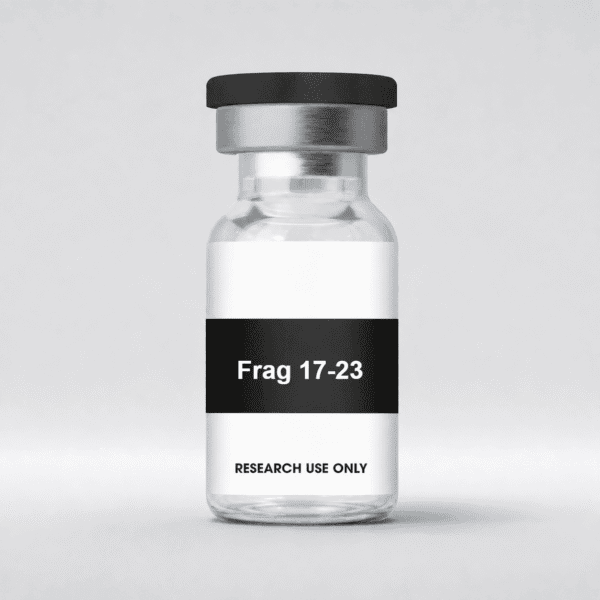
Buy Frag 17-23 peptide
$73.00
10mg*10vials
Frag 17-23 Peptide: Comprehensive Research Overview, Mechanism and Potential Applications
What Is Frag 17-23 Peptide?
Frag 17-23 is a short peptide sequence linked to studies on thymosin beta-4 (Tβ4). It is a little part of the parent thymosin beta-4 molecule and has drawn attention from scientists who are trying to figure out whether certain parts of bigger peptides may maintain certain biological characteristics.
Thymosin beta-4 is a naturally occurring peptide whose role in cellular processes like actin control, cell migration, tissue remodeling, and wound-healing biology has been well investigated. The goal of researchers examining smaller fragments like Frag 17–23 is to determine which parts of the parent molecule might be involved in specific biological processes.
HGH Fragment 176-191, which is produced from human growth hormone and constitutes a completely separate peptide, must be distinguished from Frag 17-23.
Frag 17-23 and Thymosin Beta-4
It is helpful to first comprehend Frag 17-23 in respect to thymosin beta-4.
A 43-amino acid peptide called thymosin beta-4 is found naturally in a variety of tissues and cells. Thymosin beta-4’s interaction with the cellular actin system is a key topic of study.
Actin is a crucial structural protein that affects intracellular structure, cell division, motility, and shape. Researchers have studied thymosin beta-4 in tissue remodeling, wound repair, angiogenesis, and inflammation since cellular mobility is a crucial part of many biological processes.
Within this larger field of study, fragments 17–23 are examined as a minor sequence.
Why Are Short Peptide Fragments Studied?
Peptide fragments can help researchers investigate the relationship between structure and biological activity.
A larger peptide may contain multiple regions that contribute to different biological functions. By examining shorter sequences, researchers can investigate questions such as:
- Which amino-acid regions contribute to biological activity?
- Can a smaller sequence interact with particular cellular pathways?
- Does reducing peptide size affect stability or activity?
- Which structural features are necessary for a particular biological response?
- Can specific peptide regions provide useful models for laboratory research?
This type of research is sometimes referred to as structure-function analysis and is important in peptide science.
Proposed Biological Mechanisms
Frag 17-23’s precise mechanism is not well understood enough to draw firm conclusions regarding its biological consequences.
Thymosin beta-4 research offers a more comprehensive scientific framework. Actin dynamics modulation is closely linked to the parent peptide, especially when actin sequestration is involved.
Actin is present in cells in a variety of forms, and how it is arranged can affect the shape and motion of the cell. Actin dynamics alterations are crucial for activities like tissue remodeling and cellular migration.
Because Frag 17-23 is a shorter sequence that comes from the thymosin beta-4 research family, researchers have looked into the possibility that certain peptide sections may be linked to distinct biological traits. However, Frag 17-23 should not be automatically linked to the activity shown by full-length thymosin beta-4.
Frag 17-23 and Cellular Migration Research
An essential biological process in wound healing, immunological responses, tissue remodeling, and tissue development is cell migration.
As part of the healing process, cells may migrate toward damaged tissue. This necessitates coordinated modifications to intracellular signaling, adhesion, cytoskeletal architecture, and cell shape.
In connection with these processes, thymosin beta-4 has been studied. The goal of research on Frag 17-23 is to ascertain whether a shorter peptide sequence might affect comparable biological processes.
However, a comparable impact for Frag 17-23 cannot be automatically established by laboratory results involving the parent peptide.
Frag 17-23 and Tissue Repair Research
Tissue repair is another area associated with thymosin beta-4 research.
Normal tissue repair involves several overlapping stages, including:
- Inflammatory response — damaged tissue generates signals that initiate the repair process.
- Cell migration — different cell types move toward the affected region.
- Cell proliferation — cells multiply to replace damaged or lost tissue.
- Extracellular matrix remodeling — structural components surrounding cells are reorganized.
- Maturation — repaired tissue undergoes longer-term structural changes.
Researchers investigate peptides such as thymosin beta-4 and its fragments to better understand how peptide signaling may influence these processes.
Frag 17-23 should therefore be described as a research subject in tissue-repair biology, rather than as a clinically proven tissue-repair treatment.
Frag 17-23 and Angiogenesis Research
A
The creation of new blood vessels from preexisting vascular systems is referred to as angiogenesis.
Because regenerated tissue needs a sufficient supply of oxygen and nutrients, the production of new blood vessels is crucial to tissue development and repair.
Experimental models involving angiogenesis and endothelial-cell activity have been used to study thymosin beta-4. These results have increased interest in thymosin beta-4-related peptides among scientists.
However, studies on a peptide fragment may not replicate the biological activity of the entire parent peptide, therefore results for Frag 17-23 in particular should be read cautiously.
Frag 17-23 and Inflammation Research
Immune cells, signaling chemicals, blood arteries, and tissue alterations are all involved in the intricate biological reaction known as inflammation.
Experimental studies on inflammatory reactions and tissue damage have examined thymosin beta-4. These findings have prompted more research into the potential effects of peptide signaling on inflammatory and repair pathways.
There is insufficient data to classify frag 17-23 as a proven anti-inflammatory treatment; it is still an experimental research topic.
Research Interest in Regenerative Biology
Regenerative biology has contributed to the increased interest in thymosin beta-4-related peptides.
Research on regeneration looks at how cells react to damage, rearrange tissue, interact with neighboring cells, and regain biological function.
Because they enable researchers to separate particular parts of larger molecules and study their unique properties, peptide fragments can be helpful experimental tools.
Frag 17-23 may therefore be relevant to studies exploring:
- Cellular signaling
- Cytoskeletal organization
- Cell migration
- Tissue remodeling
- Wound-repair mechanisms
- Angiogenesis
- Peptide structure-function relationships
- Regenerative biology
These areas represent research interests rather than confirmed therapeutic indications.
Frag 17-23 Compared With Thymosin Beta-4
Full-length thymosin beta-4 and fragment 17-23 should not be used interchangeably.
The entire naturally occurring peptide, thymosin beta-4, is made up of 43 amino acids.
A considerably shorter sequence linked to a section of the parent peptide is referred to as frag 17-23.
Pharmacokinetics, stability, biological activity, and molecular interactions can all be impacted by size differences.
Therefore, it is not always possible to interpret study results employing full-length thymosin beta-4 as proof that Frag 17-23 elicits the same biological response.
Frag 17-23 vs. HGH Fragment 176-191
These two peptides are frequently confused because both may be described as “fragments.”
They are nevertheless fundamentally different.
| Feature | Frag 17-23 | HGH Fragment 176-191 |
|---|---|---|
| Research association | Thymosin beta-4 | Human growth hormone |
| Parent molecule | Thymosin beta-4 | Human growth hormone |
| Peptide type | Short thymosin beta-4-related fragment | C-terminal HGH-derived fragment |
| Research focus | Cellular and tissue biology | Growth-hormone-related metabolic research |
| Identity | Different peptide | Different peptide |
A website should avoid using “HGH Frag” as a synonym for Frag 17-23 because this can create significant scientific and SEO confusion.
What Does Research Currently Tell Us?
The scientific rationale for studying Frag 17-23 comes largely from research into thymosin beta-4 and peptide structure-function relationships.
However, several important questions remain:
- What are the precise molecular targets of Frag 17-23?
- How stable is the peptide under physiological conditions?
- How is it metabolized?
- What concentrations are biologically active in experimental models?
- Does the isolated fragment reproduce activities associated with full-length thymosin beta-4?
- What are its pharmacokinetic properties?
- What are the potential short- and long-term safety considerations?
Additional laboratory and clinical research would be required to answer these questions reliably.
Pharmacokinetic Considerations
Pharmacokinetics is the study of a compound’s absorption, distribution, metabolism, and elimination when it enters a biological system.
Because peptide molecules may be vulnerable to enzyme degradation, pharmacokinetic behavior can be especially significant for short peptides.
Important research questions include:
- Peptide stability
- Enzymatic degradation
- Biological half-life
- Distribution through tissues
- Metabolic breakdown
- Clearance from the body
Without adequate pharmacokinetic studies, it is difficult to determine how Frag 17-23 behaves in humans or how experimental laboratory concentrations translate to physiological conditions.
Safety Considerations
Frag 17-23 should not be regarded as a proven medicinal treatment, but rather as an experimental peptide.
Important safety questions might go unanswered due to a lack of comprehensive clinical research. These include contaminants in research-grade preparations, immunogenicity, interactions with other medications, potential long-term effects, and unpleasant responses.
Another crucial factor in laboratory peptide research is product quality. The tagged peptide sequence of a product does not prove its safety, sterility, biological activity, or purity on its own.
For these reasons, information about Frag 17-23 should clearly distinguish laboratory research findings from clinically established evidence.
Why Peptide Purity Matters in Research
Peptide research depends heavily on analytical quality.
Researchers may evaluate peptide identity and purity using analytical techniques such as:
- High-performance liquid chromatography (HPLC)
- Mass spectrometry
- Chromatographic analysis
- Spectroscopic methods
These techniques can help characterize the molecular composition of a research sample.
For scientific accuracy, a website discussing Frag 17-23 should avoid implying that a product is suitable for human use simply because it is advertised as “high purity.”
Research Limitations
When assessing Frag 17-23, there are a number of restrictions.
First, studies on the parent thymosin beta-4 molecule are far more comprehensive than studies on the short Frag 17-23 sequence alone.
Second, it is not always possible to extrapolate scientific results from animal models or cell cultures to human clinical outcomes.
Third, there isn’t always uniformity in the language used for commercial peptides. Different peptide sequences may be given similar names by different vendors.
Rather than depending just on a product name, researchers should confirm the precise amino acid sequence, molecular identity, analytical data, and source documentation.
Frequently Asked Questions About Frag 17-23
What is Frag 17-23?
Frag 17-23 is a short peptide sequence associated with thymosin beta-4 research. It is studied to investigate potential biological activity associated with specific regions of the parent peptide.
Is Frag 17-23 the same as thymosin beta-4?
No. Thymosin beta-4 is the complete 43-amino-acid peptide, while Frag 17-23 represents a much smaller sequence.
Is Frag 17-23 the same as TB-500?
Commercial sources use different language when referring to TB-500 and fragments related to thymosin beta-4. Rather than presuming that different names correspond to identical molecules, a scientifically accurate product description should specify the precise peptide sequence.
Is Frag 17-23 the same as HGH Fragment 176-191?
No. HGH Fragment 176-191 is derived from human growth hormone, while Frag 17-23 is associated with thymosin beta-4 research.
What is Frag 17-23 researched for?
Research interest includes cellular migration, cytoskeletal processes, tissue remodeling, wound-repair biology, angiogenesis, and peptide structure-function relationships.
Is Frag 17-23 approved for medical use?
Frag 17-23 should not be presented as an approved medical treatment. Evidence regarding its safety and effectiveness in humans remains insufficient.
Does Frag 17-23 have proven benefits?
There is currently insufficient clinical evidence to describe specific human health benefits as established facts. Research findings should be interpreted according to the experimental model in which they were obtained.
Is Frag 17-23 available in bulk quantities?
Yes. We provide scalable manufacturing with volume-based pricing.
Do you provide Certificates of Analysis?
Yes. Each batch includes verifiable COA documentation.
Do you ship within the USA?
Yes. Orders are fulfilled through our U.S. distribution channel.
What purity level is provided?
≥98% purity verified via HPLC (custom specifications available upon request).
Frag 17-23 Peptide for Sale – High Purity Research Compound USA
Purchasing Frag 17-23 peptide from a reputable source is crucial if you want to guaranty uniformity, purity, and trustworthy study results. We provide top-notch research substances for metabolic studies, growth hormone fragment studies, and peptide signaling circuit analysis.
We follow regulated laboratory standards in our operations.
Purity is confirmed by analytical testing.
Every production batch has complete documentation from us.
The amino acid sequence of human growth hormone (HGH) is the source of the brief peptide fragment known as fragment 17–23. Research into metabolic signaling pathways, growth hormone fragment function, and peptide-receptor interactions makes extensive use of it. Because of its small size, it is a useful tool for studying particular biological processes related to growth hormone-derived peptides.
Key Benefits
- Growth Hormone Fragment Research – Supports studies involving HGH-derived peptide activity and signaling
- Metabolic Pathway Analysis – Applicable in cellular metabolism and energy regulation research
- Peptide-Receptor Interaction Studies – Useful for investigating binding characteristics and biological responses
- Molecular Signaling Research – Ideal for examining peptide-mediated regulatory pathways
- Advanced Peptide Profile – Designed for consistency and reproducibility in laboratory environments
What You Receive
- ≥98% purity (HPLC verified)
- Analytical validation (HPLC + Mass Spectrometry)
- Certificate of Analysis (COA) available per batch
- Laboratory-secured packaging
- Available in small batch or bulk wholesale quantities
Direct manufacturer sourcing ensures product integrity, traceability, and consistent long-term supply.
Bulk Frag 17-23 Peptide Supply
We support:
- Biotechnology research laboratories
- Pharmaceutical R&D organizations
- Academic research institutions
- Contract research organizations (CROs)
- Metabolic and peptide research centers
- International distributors
Why Professional Buyers Choose Us
- Transparent manufacturing processes
- Verified analytical testing
- Consistent batch-to-batch quality
- Competitive wholesale pricing
- Reliable U.S. and international fulfillment
We combine advanced peptide synthesis capabilities with a global distribution network, ensuring dependable research-grade supply for scientific and pharmaceutical research applications.
Final Thoughts on Frag 17-23
Because it offers the chance to investigate whether a particular segment of thymosin beta-4 can contribute to biological processes linked to the larger peptide, fragment 17–23 represents an intriguing field of peptide research.
It is an intriguing topic for laboratory research because of its possible connection to cellular migration, cytoskeletal control, tissue remodeling, angiogenesis, and regenerative biology.
However, it’s crucial to keep a firm line between clinically proven therapy and experimental research. Thymosin beta-4 research should not be used as evidence of comparable effects from Frag 17–23.
In order to develop a more comprehensive scientific understanding of this peptide fragment, research on molecular targets, stability, pharmacokinetics, biological activity, and safety will be crucial.
| Dosage | 10mg*10vials |
|---|
Related products
-

KPV
Price range: $53.00 through $59.00Select options This product has multiple variants. The options may be chosen on the product page -
IGF-1 LR3
Price range: $53.00 through $142.00Select options This product has multiple variants. The options may be chosen on the product page -
L-Carnitine
Price range: $52.00 through $63.00Select options This product has multiple variants. The options may be chosen on the product page -
TB500 (Thymosin B4 Acetate)
Price range: $58.00 through $113.00Select options This product has multiple variants. The options may be chosen on the product page
Reviews
There are no reviews yet.