Get up to 10% OFF! with coupon PBP10
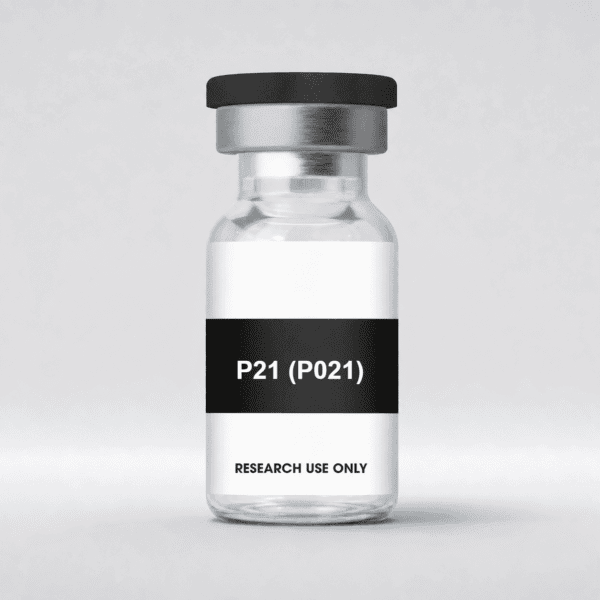
Buy p21 peptide (P021)
$199.00
5mg*10vials
Powerful p21 Peptide: Complete Research & Science Guide | Premium Bio Peptides
What Is p21 Peptide and Why Is It Important in Cellular Research?
The CDKN1A gene encodes p21, commonly referred to as p21Cip1/Waf1, a well-known regulator of cell-cycle progression. It has been thoroughly investigated in molecular and cellular biology and is a member of the Cip/Kip family of cyclin-dependent kinase inhibitors.
Because it links a number of crucial biological processes, such as cell-cycle regulation, DNA damage response, cellular senescence, transcriptional regulation, and cellular stress signaling, p21 is very intriguing.
A peptide that corresponds to a certain region or sequence of the p21 protein is referred to as a “p21 peptide.” Before starting an experiment, researchers should always confirm the precise peptide parameters because research items can vary in sequence, length, purity, and formulation.
p21 Peptide Structure and Molecular Characteristics
The human p21 protein contains 164 amino acids and has regions responsible for interactions with cyclins, cyclin-dependent kinases, and other regulatory proteins.
Unlike many compact enzymes, p21 contains structurally flexible regions that allow it to interact with multiple protein partners. This characteristic has made p21 an interesting subject for research into protein-protein interactions and intrinsically disordered protein regions.
When studying a p21-derived peptide, researchers should evaluate the specific:
- Amino-acid sequence
- Peptide length
- Molecular weight
- Chemical modifications
- Purity
- Formulation
- Batch information
These characteristics can influence peptide behavior and experimental results.
How Does p21 Work at the Molecular Level?
The main role of p21 is to inhibit cyclin-dependent kinases. It has the ability to attach to cyclin-CDK complexes and lower their kinase activity, which can affect how cells move thru the cell cycle.
The p53-p21 signaling pathway is one of the most well-known p21-related pathways. p53 can boost CDKN1A transcription in response to specific forms of cellular stress or DNA damage. Cell-cycle arrest may then result from elevated p21.
Before proceeding thru the cell cycle, this process gives cells a chance to react to stress.
Because p21 activity is highly context-dependent, its effects can vary depending on the kind of cell, the cellular environment, the level of expression, and the settings of the experiment.
p21 and Cyclin-Dependent Kinase Regulation
Cyclin-dependent kinases are enzymes that coordinate progression through different stages of the cell cycle. Their activity is regulated by cyclins, CDK inhibitors, phosphorylation, and other regulatory mechanisms.
p21 can interact with several cyclin-CDK complexes and influence their activity.
This makes p21 an important research target for understanding:
- Cell-cycle checkpoints
- CDK regulation
- DNA replication
- Cellular proliferation
- Cell-cycle arrest
- Protein-protein interactions
Laboratory studies may examine p21 expression, protein abundance, CDK activity, or interactions with specific cyclin-CDK complexes.
p21 and the p53 Signaling Pathway
The p53-p21 pathway is one of the most extensively studied regulatory systems involving p21.
When cells experience certain forms of DNA damage or other stress, p53 can become activated. Activated p53 can increase transcription of the CDKN1A gene, resulting in increased production of p21.
p21 can then inhibit specific CDK activities and contribute to cell-cycle arrest.
This pathway is important in research involving:
- DNA-damage signaling
- Cell-cycle checkpoints
- Cellular stress
- Genome stability
- Transcriptional regulation
- Cellular proliferation
Because p53 and p21 are closely connected, researchers often examine both proteins when investigating cellular responses to stress.
p21 and DNA-Damage Response Research
Maintaining genomic integrity requires cells to detect and respond to DNA damage.
p21 is one component of the broader DNA-damage response network. Increased p21 expression can contribute to temporary cell-cycle arrest following certain cellular stress conditions.
Researchers can investigate this pathway by measuring changes in p21 expression alongside other DNA-damage and checkpoint markers.
Experimental approaches may include:
- Gene-expression analysis
- Protein-expression analysis
- Cell-cycle profiling
- DNA-damage assays
- Immunoblotting
- Microscopy-based assays
The response of p21 can vary substantially depending on the type of damage and the experimental model.
p21 and Cell-Cycle Arrest
Cell-cycle arrest is a major biological process associated with p21.
By inhibiting specific cyclin-CDK complexes, p21 can reduce kinase activity required for progression through the cell cycle. This makes p21 particularly useful for research investigating how cells temporarily stop proliferation in response to stress.
Researchers can study p21 alongside markers of different cell-cycle phases to determine how experimental conditions influence cellular progression.
p21 and Cellular Senescence Research
Cellular senescence describes a state in which cells undergo a durable reduction or cessation of proliferative capacity while remaining metabolically active.
p21 is frequently investigated as one of the molecular regulators associated with senescence.
Researchers may examine p21 together with other senescence-associated markers to characterize experimental models.
It is important to recognize that p21 is not exclusively a senescence marker. Its expression can also increase during other cellular responses, including DNA damage and transient cell-cycle arrest.
Therefore, p21 measurements should generally be interpreted alongside additional markers and experimental observations.
p21 and Apoptosis-Related Research
p21 has also been studied in relation to apoptosis, or programmed cell death.
The relationship between p21 and apoptosis is complex and can depend on cellular context, localization, expression level, and other signaling pathways.
Researchers investigating this area may examine how changes in p21 interact with pathways controlling cell-cycle arrest, cellular survival, and programmed cell death.
This makes p21 relevant to broader research into cellular responses to stress.
p21 and Cancer Biology Research
p21 is an important molecular target in cancer biology research because normal cell proliferation depends on tightly controlled cell-cycle progression.
The p53-p21 pathway is particularly important because disruptions in cell-cycle checkpoints can alter cellular proliferation.
Researchers investigate p21 in many experimental models to better understand:
- Cell proliferation
- Cell-cycle checkpoints
- DNA-damage responses
- Cellular senescence
- Tumor-suppressor pathways
- Molecular mechanisms of abnormal cell growth
However, experimental findings involving p21 should not automatically be interpreted as evidence of a therapeutic effect.
p21 and Protein-Protein Interactions
One important feature of p21 biology is its ability to interact with multiple proteins.
These interactions include relationships with cyclins, CDKs, proliferating cell nuclear antigen (PCNA), and other regulatory proteins.
Studying these interactions can help researchers understand how p21 connects cell-cycle regulation with DNA replication and cellular stress responses.
Peptide fragments derived from p21 can be investigated in experimental systems designed to study specific protein-interaction domains.
p21 Peptide Research Applications
Research involving p21-derived peptides can be relevant to several areas of molecular biology.
Cell-Cycle Research
Researchers can investigate how p21-related sequences interact with proteins involved in cell-cycle progression and CDK regulation.
DNA-Damage Research
p21 is an important component of research into cellular responses following DNA damage and activation of checkpoint pathways.
Senescence Research
Researchers can study p21 expression and signaling as part of broader investigations into cellular senescence.
Protein-Interaction Research
Specific p21 sequences can be investigated to understand interactions between p21 and other cellular proteins.
Cancer Biology
p21 is frequently studied in experimental models investigating cellular proliferation and tumor-suppressor pathways.
Molecular Signaling
Research can examine how p21 participates in interconnected pathways controlling cell-cycle progression and cellular stress responses.
Key Benefits of p21 Peptide Research
Provides a Model for Cell-Cycle Regulation
p21 is a well-established regulator of cyclin-dependent kinase activity, making it valuable for studies of cell-cycle control.
Supports DNA-Damage Studies
The connection between p53 and p21 provides an established model for investigating cellular checkpoint responses.
Useful in Senescence Research
p21 can be examined alongside additional molecular markers when investigating cellular senescence.
Helps Investigate Protein Interactions
p21-derived sequences can provide research models for studying specific protein-binding interactions.
Relevant to Molecular Cancer Research
Because p21 is involved in pathways controlling cell proliferation, it remains an important target in molecular and cellular cancer research.
p21 Peptide Purity, Identity, and Quality Testing
When selecting a research peptide, identity and purity are important quality considerations.
Researchers should examine documentation that identifies the exact material and batch. Depending on the product, quality information may include:
- Peptide sequence
- Product identity
- Purity percentage
- Molecular weight
- Batch or lot number
- Analytical methodology
- Test results
- Storage recommendations
Common analytical approaches for peptide characterization can include HPLC and mass spectrometry, although the actual methods depend on the product and testing laboratory.
p21 Peptide Certificate of Analysis (COA)
A Certificate of Analysis provides batch-specific analytical information for a research material.
For a p21 peptide, applicable documentation may include the product identity, batch number, purity analysis, analytical methods, specifications, and testing date.
Researchers should confirm that the COA corresponds to the exact product and batch they are evaluating.
A COA should be considered together with the product specification sheet and other applicable documentation rather than as the sole measure of suitability for an experiment.
p21 Peptide Storage and Handling Considerations
Peptides can be sensitive to environmental conditions, and stability can vary according to their sequence and formulation.
Researchers should follow product-specific recommendations concerning:
- Temperature
- Moisture
- Light
- pH
- Solvent
- Concentration
- Storage duration
- Repeated handling
Proper laboratory handling and appropriate storage practices can help researchers maintain consistency when working with peptide research materials.
p21 Compared With p27 and Other CDK Inhibitors
p21 is part of the broader Cip/Kip family of cyclin-dependent kinase inhibitors, which also includes p27 and p57.
These proteins share certain structural and functional characteristics but differ in their regulation, expression patterns, protein interactions, and biological roles.
Comparative studies involving p21, p27, and p57 can help researchers understand how different CDK inhibitors coordinate cell-cycle regulation under different cellular conditions.
Why Is p21 Important in Molecular Biology Research?
p21 is important because it connects multiple fundamental cellular processes.
Its involvement in CDK regulation, cell-cycle arrest, DNA-damage responses, p53 signaling, senescence, and cellular stress makes it an especially useful research target.
Studying p21 can provide researchers with a broader understanding of how cells regulate proliferation and respond to potentially damaging conditions.
P21 (P021) Peptide for Sale – High Purity Research Compound USA
If you are searching for P21 (P021) peptide for sale, sourcing from a verified manufacturer is essential to ensure purity, consistency, and reliable research outcomes. We supply high-quality research compounds for neuroregeneration studies, cognitive enhancement pathway research, and neurotrophic signaling analysis.
We follow strict laboratory guidelines.
We use analytical testing to confirm purity.
For each production batch, we offer comprehensive documentation.
Research on neurogenesis, synaptic plasticity, and neural growth signaling pathways makes extensive use of P21 (P021), a synthetic peptide generated from a portion of ciliary neurotrophic factor (CNTF). It is a useful substance for cutting-edge neuroscience research since it is frequently investigated for its ability to improve hippocampus function, neuronal differentiation, and brain plasticity mechanisms.
What You Receive
- ≥98% purity (HPLC verified)
- Analytical validation (HPLC + Mass Spectrometry)
- Certificate of Analysis (COA) available per batch
- Laboratory-secured packaging
- Available in small batch or bulk wholesale quantities
Direct manufacturer sourcing ensures product integrity, traceability, and consistent long-term supply.
Bulk P21 (P021) Supply
We support:
- Biotechnology research laboratories
- Pharmaceutical R&D organizations
- Academic research institutions
- Contract research organizations (CROs)
- Neuroscience and cognitive research centers
- International distributors
Frequently Asked Questions About p21 Peptide
What Is p21 Peptide?
p21 peptide generally refers to a research peptide based on a specific sequence or region of the p21 protein. The exact characteristics depend on the peptide product being studied.
What Is p21 Also Called?
p21 is commonly referred to as p21Cip1, p21Waf1, or CDKN1A.
What Does p21 Do?
p21 can inhibit specific cyclin-dependent kinases and contribute to cell-cycle regulation, particularly in response to cellular stress and DNA damage.
What Is the Relationship Between p21 and p53?
p53 can promote CDKN1A expression under certain cellular stress conditions. Increased p21 can then contribute to cell-cycle arrest.
Is p21 a Senescence Marker?
p21 is commonly studied in senescence research, but it is not exclusively a senescence marker. Researchers generally evaluate it together with other markers and experimental evidence.
Why Is p21 Important in Cancer Research?
p21 participates in cell-cycle checkpoints and proliferation control, making it an important molecular target for investigating mechanisms involved in abnormal cell growth.
How Can Researchers Verify p21 Peptide Quality?
Researchers should review the exact peptide sequence, identity, purity, molecular characteristics, batch information, analytical testing, and applicable Certificate of Analysis.
Is P21 (P021) available in bulk quantities?
Yes. We provide scalable manufacturing with volume-based pricing.
Do you provide Certificates of Analysis?
Yes. Each batch includes verifiable COA documentation.
Do you ship within the USA?
Yes. Orders are fulfilled through our U.S. distribution channel.
What purity level is provided?
≥98% purity verified via HPLC (custom specifications available upon request).
Why Choose Premium Bio Peptides?
Premium Bio Peptides provides research-focused peptide information, educational resources, and quality documentation designed to help qualified researchers evaluate research materials.
Our goal is to make scientific information easier to understand while emphasizing product-specific documentation, analytical transparency, and responsible research practices.
Researchers should review the documentation associated with the specific product and batch and follow appropriate laboratory procedures.
Important Research-Use Information
This content is provided for general scientific and educational purposes. It is not medical advice and should not be interpreted as instructions for personal use, treatment, or diagnosis.
Researchers should follow applicable laboratory procedures, safety requirements, regulations, and product-specific documentation when evaluating or handling research materials.
Research-use products are not intended for human or veterinary use, diagnosis, treatment, or prevention of disease.
| Dosage | 5mg*10vials |
|---|
Related products
-

GHRP-2 Peptide
Price range: $52.00 through $66.00Select options This product has multiple variants. The options may be chosen on the product page -
Hexarelin Acetate Peptide
Price range: $58.00 through $89.00Select options This product has multiple variants. The options may be chosen on the product page -
IGF-1 LR3
Price range: $53.00 through $142.00Select options This product has multiple variants. The options may be chosen on the product page -
KPV
Price range: $53.00 through $59.00Select options This product has multiple variants. The options may be chosen on the product page

Reviews
There are no reviews yet.