Get up to 10% OFF! with coupon PBP10

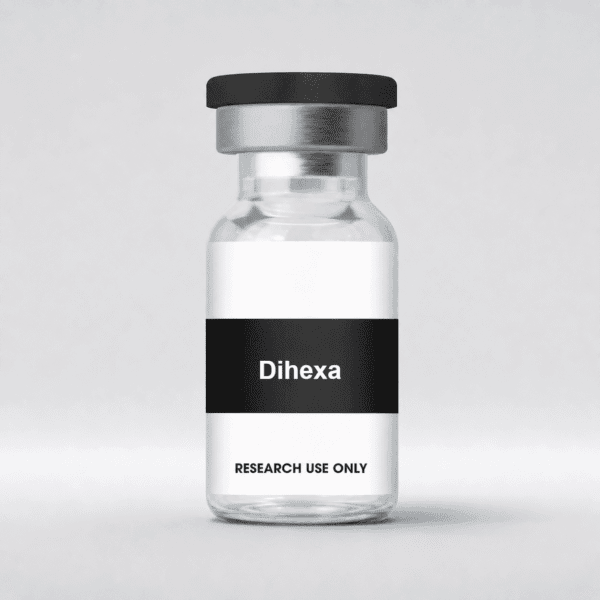
Buy Dihexa Peptide
Price range: $55.00 through $67.00
Powerful Dihexa: Complete Research, Mechanism & Science Guide | Premium Bio Peptides
What Is Dihexa?
dihexa peptide is a synthetic small molecule produced from angiotensin IV that has garnered attention in preclinical studies concerning the hepatocyte growth factor (HGF)/c-Met pathway, cellular signaling, neurobiology, and synaptic function.
The common scientific name for it is N-hexanoic-Tyr-Ile-(6) aminohexanoic amide. Dihexa was created using chemicals linked to angiotensin IV and has been studied due to its capacity to interact with signaling processes connected to HGF.
The suggested interaction between Dihexa and HGF, which is followed by regulation of c-Met receptor signaling, is a particularly significant field of study. Researchers have studied effects related to synaptic connection and hippocampus spine development in experimental neuronal models. The PubMed
However, there is still a lot of preclinical data regarding Dihexa. It is not appropriate to interpret results from animal models and cell cultures as proven therapeutic effects for humans.
Dihexa Structure and Molecular Characteristics
Dihexa differs from conventional peptide research materials because it is a synthetic small-molecule analog derived from angiotensin IV.
Its molecular design was intended to address limitations associated with earlier angiotensin IV-related compounds, including metabolic stability and access to the central nervous system. Research has described Dihexa Peptide as a blood-brain-barrier-permeable analog.
For laboratory evaluation, researchers should distinguish between:
- Chemical identity
- Molecular structure
- Molecular weight
- Purity
- Batch information
- Analytical characterization
- Formulation
- Storage requirements
These characteristics are important when comparing research materials or attempting to reproduce published experimental findings.
How Does Dihexa Peptide Work?
HGF/c-Met signaling is the best-characterized research mechanism.
According to research that was published in the Journal of Pharmacology and Experimental Therapeutics, Dihexa has a high affinity for HGF and, in certain experimental settings, can increase HGF-dependent activation of c-Met. The same study looked into downstream consequences related to synaptogenesis and hippocampus spinogenesis. [PubMed]
A more realistic scientific description of Dihexa would be that it can modify HGF-dependent c-Met signaling, rather than just “activating c-Met,” according to experimental data.
The experimental model, endogenous HGF availability, receptor expression, concentration, exposure duration, and cellular milieu all influence the exact biological response.
Dihexa and HGF/c-Met Signaling
The hepatocyte growth factor/c-Met system is a major cellular signaling pathway.
The c-Met receptor is a receptor tyrosine kinase that is bound by the signaling molecule HGF. Numerous cellular functions, including signaling linked to growth, migration, differentiation, and survival, can be impacted by activation of this system.
Dihexa has been studied as a modulator of HGF. Researchers found that at dosages where Dihexa by itself did not result in the same degree of receptor activation, Dihexa might increase HGF-dependent c-Met phosphorylation.
Because of this, one of the most crucial pathways to talk about when describing Dihexa research is the HGF/c-Met pathway.
Dihexa Peptide and c-Met Receptor Research
c-Met, also known as the HGF receptor, is a receptor tyrosine kinase involved in complex intracellular signaling.
Researchers investigating Dihexa can examine:
- c-Met phosphorylation
- HGF-dependent signaling
- Receptor activation
- Intracellular kinase pathways
- Cellular responses
- Protein-protein interactions
- Changes in neuronal signaling
In the published Dihexa research, inhibition of HGF or c-Met signaling reduced experimental effects associated with Dihexa, supporting the importance of this pathway in the observed responses.
Dihexa Peptide and Neurobiology Research
Dihexa has received considerable attention in neurobiology research because HGF and c-Met are present in the nervous system.
Earlier research identified HGF and c-Met expression in several brain regions, including the cerebral cortex and hippocampus, and investigated HGF as a neurotrophic signaling factor.
This background provides an important scientific basis for studying compounds that influence HGF/c-Met signaling in neural models.
Dihexa research has therefore focused on areas such as:
- Neuronal signaling
- Hippocampal biology
- Synaptic structure
- Neuroplasticity
- Cellular communication
- Growth-factor signaling
Dihexa and Synaptogenesis Research
Synaptogenesis refers to the formation of synaptic connections between neurons.
One of the most notable areas of Dihexa research involves experimental evidence of increased synaptic structures in hippocampal neuronal models.
A published study reported that Dihexa and related compounds induced spinogenesis and synaptogenesis in hippocampal preparations, with these effects being inhibited by an HGF antagonist or suppression of c-Met expression.
These findings make Dihexa particularly interesting for researchers studying the molecular mechanisms underlying synaptic development and remodeling.
Dihexa Peptide and Dendritic Spine Research
Dendritic spines are small structures on neuronal dendrites that participate in synaptic communication.
Changes in spine number, shape, and organization are widely studied as indicators of synaptic plasticity.
In experimental hippocampal models, Dihexa was reported to increase spine formation. The study also found evidence that the response depended on HGF/c-Met signaling.
Researchers can use these findings as a basis for investigating the relationship between growth-factor signaling and structural changes in neurons.
Dihexa and Neuroplasticity Research
Neuroplasticity describes the ability of the nervous system to modify its structure and function in response to experience, development, environmental conditions, and other influences.
Because Dihexa has been studied in connection with HGF/c-Met signaling and hippocampal synaptic structures, it has become a subject of experimental neuroplasticity research.
Potential research questions include:
- How does HGF/c-Met signaling influence synaptic structure?
- What molecular pathways regulate dendritic spine formation?
- How do growth-factor signals affect neuronal connectivity?
- What role does c-Met signaling play in hippocampal plasticity?
These remain research questions rather than established clinical conclusions.
Dihexa and Cognitive Research
Dihexa has also been investigated in animal models of learning and memory.
In the published experimental research, the cognitive effects observed in a Morris water maze model were blocked when HGF signaling was antagonized, providing evidence supporting involvement of the HGF/c-Met system.
This is an important distinction for an SEO page: it is more accurate to describe Dihexa as a compound studied in preclinical cognitive models rather than claiming that it improves memory in humans.
There is currently insufficient clinical evidence to establish Dihexa as a proven cognitive treatment.
Dihexa and Cellular Signaling Research
Dihexa provides researchers with an experimental model for examining how extracellular signaling can influence intracellular pathways.
Research can investigate:
- HGF binding
- c-Met phosphorylation
- Receptor-mediated signaling
- Protein interactions
- Cellular responses
- Neuronal signaling
- Synaptic pathways
Understanding these mechanisms can help researchers study the relationship between growth-factor signaling and neuronal structure.
Dihexa Research Applications
HGF/c-Met Research
Dihexa is particularly relevant to experiments investigating HGF-dependent c-Met signaling and receptor phosphorylation.
Neuroscience Research
Researchers can investigate its relationship with hippocampal signaling, neuronal communication, and neural pathways.
Synaptic Biology
Experimental models can examine dendritic spine formation and synaptic connectivity.
Neuroplasticity Research
Dihexa provides a research model for investigating molecular pathways associated with changes in neuronal structure.
Cognitive Neuroscience
Animal studies have examined learning and memory-related outcomes, making Dihexa relevant to preclinical cognitive research.
Molecular Signaling
Researchers can study the relationship between HGF, c-Met, and downstream intracellular signaling.
Key Benefits of Dihexa Research
1. Useful for HGF/c-Met Studies
Dihexa provides an experimental compound for investigating HGF-dependent c-Met signaling.
2. Valuable for Synaptic Research
Published preclinical work has investigated Dihexa in relation to hippocampal spine formation and synaptogenesis.
3. Supports Neuroplasticity Research
Its connection with synaptic structure makes Dihexa relevant to experimental studies of neuronal plasticity.
4. Relevant to Cognitive Models
Animal research has investigated Dihexa in learning and memory paradigms.
5. Useful for Mechanistic Research
Dihexa provides researchers with an opportunity to investigate relationships between molecular signaling and changes in neuronal structure.
Dihexa Purity and Quality Testing
For research materials, identity and analytical quality are important considerations.
Researchers should review documentation that identifies the exact compound and batch. Depending on the supplier, relevant information may include:
- Chemical identity
- Molecular formula
- Molecular weight
- Purity
- Batch or lot number
- Analytical methodology
- Test results
- Storage information
- Product specifications
Analytical characterization may involve techniques such as HPLC and mass spectrometry, depending on the material and testing laboratory.
Researchers should rely on the actual analytical documentation supplied for the specific batch rather than assuming that results from another batch apply.
Dihexa Certificate of Analysis (COA)
A Certificate of Analysis (COA) provides batch-specific analytical information about a research material.
A Dihexa COA may contain:
- Product identification
- Batch number
- Purity
- Analytical method
- Test results
- Testing date
- Applicable specifications
Researchers should verify that the COA corresponds to the exact material being evaluated.
A COA is an important quality document, but researchers should also consider the product specification, analytical methodology, and intended experimental application.
Dihexa Storage and Handling Considerations
Storage conditions can influence the stability of research compounds.
Researchers should follow the product-specific documentation concerning:
- Temperature
- Moisture
- Light exposure
- Container requirements
- Solvent compatibility
- Storage duration
- Handling procedures
Because Dihexa is a small molecule rather than a conventional protein peptide, researchers should follow the storage specifications provided specifically for the material instead of applying generic peptide-storage assumptions.
Dihexa vs. Angiotensin IV
Dihexa is originated from research on angiotensin IV, however it has undergone chemical modification to create a more stable counterpart.
When comparing the two compounds, this distinction is crucial.
Dihexa is a synthetic analog intended for experimental study, while angiotensin IV is a naturally occurring peptide linked to the renin-angiotensin system.
Research attempts to modify angiotensin IV-related structures to change stability and biological features are reflected in the development of Dihexa.
Dihexa vs. Other Neuroactive Research Compounds
Dihexa should not automatically be grouped with every compound marketed as a “nootropic” or “neuroprotective peptide.”
Its scientific identity and proposed mechanism are more specifically associated with angiotensin IV-derived chemistry and HGF/c-Met signaling.
When comparing Dihexa with other research compounds, researchers should consider:
- Chemical structure
- Molecular target
- Mechanism
- Experimental evidence
- Model system
- Analytical quality
- Published literature
This approach provides a more scientifically meaningful comparison than simply ranking compounds by claimed benefits.
What Does the Scientific Research Actually Show?
Dihexa binds HGF with high affinity and increases HGF-dependent c-Met signaling, according to one of the most significant studies. In experimental models, the researchers also noted impacts on hippocampus spinogenesis and synaptogenesis.
In order to determine if the observed effects were caused by the HGF/c-Met system, the same study employed HGF antagonism and c-Met suppression. When this route was blocked, the experimental responses decreased.
These findings provide a mechanistic basis for continued research, but they remain preclinical findings. They should not be presented as evidence that Dihexa is safe, effective, or approved for human use.
Why Is Dihexa Interesting for Research?
Dihexa is scientifically interesting because it sits at the intersection of several research fields:
Molecular biology → HGF/c-Met signaling → neuronal signaling → synaptic structure → neuroplasticity → behavioral research
This interconnected mechanism makes it a useful subject for researchers investigating how molecular signals can influence neuronal structure and function.
Its experimental profile also illustrates why researchers should evaluate both mechanistic evidence and the limitations of preclinical studies.
Frequently Asked Questions About Dihexa
What Is Dihexa?
Dihexa is a synthetic angiotensin IV-derived small molecule investigated primarily in preclinical research involving HGF/c-Met signaling, neuroscience, synaptic biology, and cognition.
Is Dihexa Actually a Peptide?
Dihexa is more accurately described as a synthetic small-molecule analog derived from an angiotensin IV peptide, rather than a conventional peptide.
What Is Dihexa Studied For?
Research has examined Dihexa in relation to HGF/c-Met signaling, neuronal biology, synaptogenesis, dendritic spine formation, neuroplasticity, and animal models of learning and memory.
What Is the HGF/c-Met Pathway?
HGF/c-Met is a signaling system involved in numerous cellular processes. c-Met is the receptor for HGF, and activation can initiate multiple intracellular signaling pathways.
Does Dihexa Improve Memory?
Preclinical animal research has reported cognitive effects in experimental models, but these findings do not establish a cognitive benefit in humans.
What Is Dihexa Used for in Research?
It can be investigated as an experimental compound in studies involving receptor signaling, neuronal pathways, synaptic biology, neuroplasticity, and molecular mechanisms.
Is Dihexa Peptide available in bulk quantities?
Yes. We provide scalable manufacturing with volume-based pricing.
Do you provide Certificates of Analysis?
Yes. Each batch includes verifiable COA documentation.
Do you ship within the USA?
Yes. Orders are fulfilled through our U.S. distribution channel.
What purity level is provided?
≥98% purity verified via HPLC (custom specifications available upon request).
How Should Researchers Evaluate Dihexa Peptide Quality?
Researchers should review the exact chemical identity, purity, batch information, analytical testing, Certificate of Analysis, and product-specific documentation.
Dihexa Peptide for Sale – High Purity Research Compound USA
Purchasing Dihexa peptide from a reputable manufacturer is crucial to guaranteeing purity, consistency, and trustworthy study results. We provide top-notch research substances for neurotrophic signaling analysis, cognitive pathway study, and neuroscience investigations.
We work according to strict laboratory guidelines.
Analytical testing is how we confirm purity.
For each production batch, we offer complete documentation.
Dihexa Peptide is a synthetic oligopeptide derivative that was first created by study on angiotensin IV. It is frequently used in research on neurotrophic activity, cognitive pathway analysis, synaptic signaling, and neural communication. Because of its distinct function, it is a useful research chemical for studying cellular communication and neuronal connections in the central nervous system.
What You Receive
- ≥98% purity (HPLC verified)
- Analytical validation (HPLC + Mass Spectrometry)
- Certificate of Analysis (COA) available per batch
- Laboratory-secured packaging
- Available in small batch or bulk wholesale quantities
Direct manufacturer sourcing ensures product integrity, traceability, and consistent long-term supply.
Bulk Dihexa Peptide Supply
We support:
- Biotechnology research laboratories
- Pharmaceutical R&D organizations
- Academic research institutions
- Contract research organizations (CROs)
- Neuroscience and neurobiology research centers
- International distributors
Why Choose Premium Bio Peptides?
Premium Bio Peptides is committed to providing clear, research-focused information about peptides and related research compounds.
Our resources emphasize:
- Scientific background
- Research applications
- Product information
- Analytical documentation
- Certificates of Analysis
- Quality considerations
- Responsible research practices
Our goal is to make research-related information easier to understand while encouraging researchers to evaluate primary scientific literature and product-specific documentation.
Important Research-Use Statement
The information on this page is provided for scientific and educational purposes only. Discussion of Dihexa research does not constitute medical advice, a recommendation for human use, or evidence of clinical efficacy.
Researchers should consult appropriate scientific literature, follow applicable laboratory procedures and regulations, and evaluate product-specific documentation before conducting research.
Research materials are not intended for human or veterinary use, diagnosis, treatment, or prevention of disease.
| Dosage | 5mg*10vials, 10mg*10vials |
|---|
Related products
-

KPV
Price range: $53.00 through $59.00Select options This product has multiple variants. The options may be chosen on the product page -
GHK-CU
Price range: $46.00 through $48.00Select options This product has multiple variants. The options may be chosen on the product page -
Hexarelin Acetate Peptide
Price range: $58.00 through $89.00Select options This product has multiple variants. The options may be chosen on the product page -
CJC 1295 With DAC Peptide
Price range: $75.00 through $125.00Select options This product has multiple variants. The options may be chosen on the product page
Reviews
There are no reviews yet.