Get up to 10% OFF! with coupon PBP10
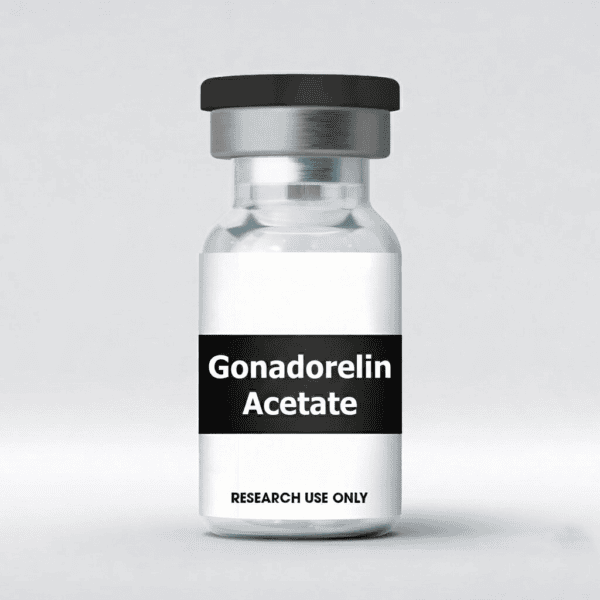
Gonadorelin Acetate Peptide
Price range: $49.00 through $58.00
2mg*10vials
Gonadorelin Acetate – Comprehensive Research & Scientific Guide
What Is Gonadorelin Acetate?
Gonadorelin acetate is the acetate salt of gonadorelin, a synthetic form of gonadotropin-releasing hormone (GnRH). Gonadorelin is a naturally occurring hypothalamic signaling hormone that regulates the release of the pituitary gonadotropins luteinizing hormone (LH) and follicle-stimulating hormone (FSH). Current U.S. labeling identifies gonadorelin as a decapeptide with the sequence pGlu-His-Trp-Ser-Tyr-Gly-Leu-Arg-Pro-Gly-NH₂.
For scientific research, this molecule is particularly valuable as a defined model for studying the communication between the hypothalamus, pituitary gland, and reproductive system.
Gonadorelin Acetate Structure and Molecular Characteristics
Gonadorelin is a 10-amino-acid peptide, making it a decapeptide. The commonly reported sequence is:
pGlu-His-Trp-Ser-Tyr-Gly-Leu-Arg-Pro-Gly-NH₂
The free peptide has a reported molecular weight of approximately 1,182.32 Da. The acetate form represents the salt formulation of the peptide.
Understanding the molecular structure is important when evaluating peptide identity, purity, analytical data, and stability in laboratory applications.
How Gonadorelin Acetate Works
Gonadorelin functions as an agonist of the GnRH receptor located on pituitary gonadotroph cells.
Under normal physiology, GnRH is released from the hypothalamus in pulses. These pulses stimulate the pituitary to synthesize and release LH and FSH. The pattern and frequency of GnRH signaling help regulate reproductive hormone activity.
This makes gonadorelin an important research tool for investigating endocrine signaling and the hypothalamic-pituitary-gonadal axis.
Gonadorelin Peptide and GnRH Receptor Signaling
The GnRH receptor is a G-protein-coupled receptor expressed primarily on pituitary gonadotroph cells.
When gonadorelin interacts with the receptor, intracellular signaling is initiated. This ultimately contributes to the synthesis and secretion of LH and FSH.
Researchers can use this signaling system to study:
- GnRH receptor activity
- Pituitary signaling
- Gonadotropin secretion
- Endocrine feedback
- Reproductive hormone regulation
- Peptide-receptor interactions
The physiological response is strongly influenced by the pattern of exposure, because continuous and pulsatile GnRH signaling can produce different endocrine responses.
Gonadorelin Acetate and Luteinizing Hormone
LH is one of the primary pituitary hormones regulated by GnRH.
Research involving gonadorelin can therefore be used to investigate how GnRH receptor stimulation influences LH release and downstream reproductive signaling.
In physiological systems, LH participates in processes including ovulation, corpus-luteum function, and testosterone production in males.
The relationship between gonadorelin and LH provides an important experimental model for studying endocrine regulation.
Gonadorelin Acetate and Follicle-Stimulating Hormone
FSH is another major gonadotropin regulated by GnRH.
FSH contributes to reproductive processes including follicular development in females and spermatogenic support in males.
Research involving gonadorelin allows investigators to examine the relationship between hypothalamic GnRH signaling and pituitary FSH secretion.
Because LH and FSH responses can vary according to GnRH pulse patterns, experimental designs must carefully consider exposure conditions when interpreting results.
Gonadorelin Acetate in Reproductive Research
Reproductive endocrinology is one of the major scientific fields associated with gonadorelin.
Researchers use GnRH-related models to investigate the regulation of:
- LH secretion
- FSH secretion
- Gonadal function
- Ovulatory signaling
- Follicular development
- Spermatogenesis
- Sex-hormone feedback
- Hypothalamic-pituitary communication
Gonadorelin therefore provides a useful experimental model for understanding how peptide hormones regulate reproductive physiology.
Gonadorelin Acetate and the Hypothalamic-Pituitary-Gonadal Axis
The hypothalamic-pituitary-gonadal (HPG) axis is a central endocrine system involved in reproductive function.
The basic signaling pathway can be summarized as:
Hypothalamus → GnRH → Pituitary → LH/FSH → Gonads → Sex hormones
Gonadorelin provides researchers with a defined way to investigate the GnRH portion of this pathway.
Changes in GnRH signaling can subsequently influence pituitary gonadotropins and downstream reproductive hormones, making the system valuable for endocrine research.
Gonadorelin Acetate Pharmacological Research
Pharmacological studies can examine how gonadorelin interacts with its receptor and how changes in exposure influence endocrine responses.
Important research parameters may include:
- Receptor activation
- Hormone-release patterns
- Exposure duration
- Peptide clearance
- Pharmacokinetic behavior
- Pituitary responsiveness
- Reproductive hormone changes
One of the important characteristics of GnRH biology is that pulsatile signaling and continuous exposure are not equivalent. The temporal pattern of receptor stimulation can substantially influence downstream endocrine activity.
Gonadorelin Acetate Stability and Storage Considerations
Peptide stability is an important consideration for laboratory research.
Factors that can influence peptide integrity include:
- Temperature
- pH
- Moisture
- Light exposure
- Oxidation
- Repeated handling
- Solvent conditions
- Enzymatic degradation
Researchers should follow the storage and handling specifications supplied with the particular research material rather than assuming that all gonadorelin acetate preparations have identical stability characteristics.
Analytical testing such as chromatography and mass spectrometry can help evaluate identity, purity, and degradation.
Gonadorelin Acetate Research Applications
Gonadorelin can support research across several areas of biology and pharmacology.
Endocrine Research
Used to investigate hypothalamic and pituitary hormone signaling.
Reproductive Biology
Provides a model for studying the regulation of reproductive hormones.
GnRH Receptor Research
Useful for investigating peptide-receptor interactions and receptor-mediated signaling.
LH and FSH Studies
Can help researchers examine how GnRH signaling influences pituitary gonadotropin secretion.
HPG-Axis Research
Provides an experimental tool for studying communication between the hypothalamus, pituitary, and gonads.
Peptide Pharmacology
Can be used to investigate peptide structure, receptor activation, biological activity, and pharmacological behavior.
Potential Research Benefits
For a research website, it is more accurate to describe these as potential research applications rather than proven therapeutic benefits.
- Defined GnRH model — Provides a chemically defined form of GnRH for controlled experimental research.
- Pituitary signaling studies — Helps researchers investigate LH and FSH secretion.
- Reproductive endocrinology research — Supports studies of hormonal regulation within the HPG axis.
- Receptor research — Offers a model for investigating GnRH receptor activation.
- Peptide pharmacology — Useful for examining structure, activity, and biological responses.
- Hormone regulation research — Helps researchers study interactions between hypothalamic and pituitary signaling.
- Comparative peptide studies — Can be compared with synthetic GnRH analogs and related compounds.
These applications should not be interpreted as evidence that a research-grade product provides therapeutic benefits.
Current Scientific Evidence
Gonadorelin is a well-characterized GnRH peptide with established physiological activity. Current U.S. labeling confirms its identity as a decapeptide and describes its role in stimulating pituitary release of LH and FSH.
Importantly, gonadorelin should not be confused with GnRH antagonists such as ganirelix. Gonadorelin activates the GnRH receptor, whereas ganirelix competitively blocks the receptor and suppresses gonadotropin secretion.
This distinction is particularly important when creating educational content because GnRH agonists, antagonists, and longer-acting analogs can produce substantially different physiological effects.
Gonadorelin Acetate vs Gonadorelin
The terms are closely related.
Gonadorelin refers to the active peptide itself, while gonadorelin acetate refers to a salt form containing gonadorelin associated with acetate.
For example, the FDA-listed veterinary product GONAbreed contains gonadorelin as gonadorelin acetate.
Researchers should always check the specific product documentation to determine the exact formulation, concentration, excipients, and analytical specifications.
Gonadorelin Acetate vs Other GnRH Peptides
Gonadorelin is the synthetic counterpart of naturally occurring GnRH.
Other compounds in this category may contain structural modifications designed to alter receptor activity, duration, or metabolic stability.
For example, leuprolide is a synthetic GnRH analog with structural modifications that distinguish it from native gonadorelin.
Ganirelix, by contrast, is a GnRH antagonist rather than an agonist.
Understanding these distinctions is essential when comparing compounds for scientific research.
Research Limitations and Considerations
Although gonadorelin is well characterized, experimental results can vary depending on the research model.
Important considerations include:
- Species differences
- Receptor expression
- Exposure pattern
- Peptide concentration
- Route of administration
- Experimental duration
- Baseline endocrine status
- Hormonal feedback mechanisms
Continuous exposure should not automatically be interpreted as equivalent to physiological pulsatile GnRH secretion.
Researchers should therefore evaluate experimental conditions carefully when comparing results across studies.
Is Gonadorelin Acetate FDA Approved?
The regulatory status depends on the specific formulation, product, indication, and species.
Current U.S. labeling lists gonadorelin products approved for specific veterinary uses. For example, GONAbreed is FDA-approved under an animal-drug application for specified reproductive uses in cattle. Cystorelin is also listed as an FDA-approved animal drug for specified cattle indications.
This does not mean that every gonadorelin acetate research product is FDA-approved or that a research-grade peptide is approved for human use.
Is Gonadorelin Acetate Intended for Research Use?
A research-grade product should be clearly distinguished from an approved pharmaceutical formulation.
For laboratory use, researchers should verify the product’s:
- Identity
- Purity
- Lot number
- Certificate of Analysis
- Molecular characterization
- Storage requirements
- Applicable regulatory status
Research-grade material should not be represented as an alternative to an approved prescription or veterinary product.
Gonadorelin Acetate FAQs
What is Gonadorelin Acetate?
It is a salt form of gonadorelin, a synthetic decapeptide corresponding to GnRH. It is studied for its role in GnRH receptor signaling and regulation of pituitary gonadotropins.
What is the sequence of gonadorelin?
The commonly reported sequence is pGlu-His-Trp-Ser-Tyr-Gly-Leu-Arg-Pro-Gly-NH₂.
What does gonadorelin stimulate?
GnRH stimulates the pituitary to release LH and FSH.
What is the role of gonadorelin in reproductive research?
It provides a defined experimental model for studying GnRH signaling, pituitary gonadotropins, and the hypothalamic-pituitary-gonadal axis.
Is gonadorelin the same as ganirelix?
No. Gonadorelin is a GnRH agonist, while ganirelix is a GnRH antagonist that blocks the GnRH receptor.
Is gonadorelin the same as leuprolide?
No. Leuprolide is a structurally modified GnRH analog, whereas gonadorelin corresponds to native GnRH.
What is gonadorelin studied for?
Research applications include endocrine signaling, LH and FSH regulation, reproductive biology, GnRH receptor studies, and HPG-axis research.
How is gonadorelin characterized?
Laboratories may use techniques such as HPLC and mass spectrometry to evaluate identity, purity, molecular mass, and degradation.
Is Gonadorelin Acetate FDA approved?
Specific gonadorelin formulations have FDA approval for certain veterinary indications. Approval applies to the particular labeled product and indication and should not be generalized to research-grade material.
Is Gonadorelin Acetate intended for human use?
Research-grade material should not be represented as an approved human medication. Researchers should rely on applicable regulatory labeling for any pharmaceutical product.
Is Gonadorelin available in bulk quantities?
Yes. We provide scalable manufacturing with volume-based pricing.
Do you provide Certificates of Analysis?
Yes. Each batch includes verifiable COA documentation.
Do you ship within the USA?
Yes. Orders are fulfilled through our U.S. distribution channel.
What purity level is provided?
≥98% purity verified via HPLC (higher specifications available upon request).
Gonadorelin Peptide for Sale – High Purity Research Compound USA
To guaranty purity, consistency, and trustworthy study results, you must purchase Gonadorelin peptide for sale from a reputable producer. As a licensed peptide manufacturer, we provide premium research substances for neuroendocrine, hypothalamus signaling, and reproductive hormone studies.
We follow strict laboratory guidelines.
We use analytical testing to confirm purity.
For each production batch, we offer comprehensive documentation.
Similar to gonadotropin-releasing hormone (GnRH), gonadorelin is a synthetic decapeptide that is frequently used in studies pertaining to the hypothalamic-pituitary-gonadal (HPG) axis. It is essential to research on reproductive signaling pathways, endocrine system regulation, and the release of luteinizing hormone (LH) and follicle-stimulating hormone (FSH).
What You Receive
- ≥98% purity (HPLC verified)
- Analytical validation (HPLC + Mass Spectrometry)
- Certificate of Analysis (COA) available per batch
- Laboratory-secured packaging
- Available in small batch or bulk wholesale quantities
Direct manufacturer sourcing ensures product integrity, traceability, and consistent long-term supply.
Bulk Gonadorelin Peptide Supply
We support:
- Biotechnology research laboratories
- Pharmaceutical R&D organizations
- Academic research institutions
- Contract research organizations (CROs)
- Endocrinology and reproductive research centers
- International peptide distributors
Why Professional Buyers Choose Us
- Transparent manufacturing processes
- Verified analytical testing
- Consistent batch-to-batch quality
- Competitive wholesale pricing
- Reliable U.S. and international fulfillment
We combine advanced peptide synthesis capabilities with a global distribution network, ensuring dependable research-grade supply at scale.
Final Thoughts on Gonadorelin Acetate
Gonadorelin acetate is an important peptide in endocrine and reproductive research because it provides a defined form of gonadotropin-releasing hormone (GnRH). Its activity is closely associated with GnRH receptor signaling and the regulation of pituitary LH and FSH secretion.
Its well-defined decapeptide structure makes it useful for investigating peptide-receptor interactions, endocrine signaling, reproductive physiology, and the hypothalamic-pituitary-gonadal axis.
For Premium Bio Peptides, the strongest SEO approach is to combine accurate scientific information with related terms such as GnRH peptide, gonadotropin-releasing hormone, LH, FSH, reproductive research, pituitary signaling, peptide structure, and HPG axis rather than repeatedly using the exact phrase “Gonadorelin Acetate.”
Research-use statement: Information on this page is provided for scientific and educational purposes. Research-grade compounds should not be presented as approved treatments or as recommendations for human or veterinary administration.
| Dosage | 2mg*10vials, 5mg*10vials |
|---|
Related products
-

Melatonin
$72.00 -
HMG
$64.00 -
Glutathione
Price range: $44.00 through $87.00Select options This product has multiple variants. The options may be chosen on the product page -
Retatrutide
Price range: $65.00 through $259.00Select options This product has multiple variants. The options may be chosen on the product page
Reviews
There are no reviews yet.