Get up to 10% OFF! with coupon PBP10
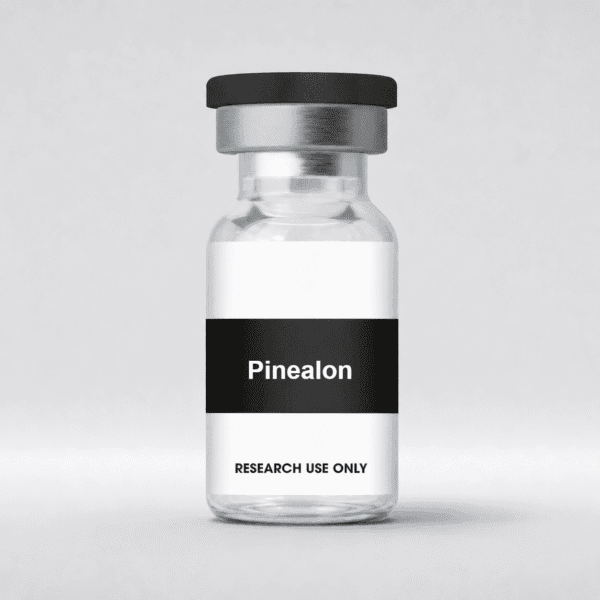
Buy pinealon peptide
Price range: $52.00 through $64.00
Pinealon Peptide: Benefits, Uses, Safety and Research
Research on cellular function, oxidative stress, neurological processes, and healthy aging has shown interest in pinealon peptide, a short synthetic peptide. It is connected to the research on bioregulator peptides conducted by Vladimir Khavinson and associates.
Research indicates that this molecule may affect how cells react to oxidative stress and other biological processes, which has raised interest in it. It is crucial to differentiate between established medicinal advantages and exploratory research findings. Modern controlled human clinical evidence is still scarce, and a large portion of the information that is currently accessible comes from laboratory and preclinical research.
What Is the Pinealon Peptide?
The amino acids glutamic acid, aspartic acid, and arginine make up the synthetic tripeptide known as pinealon, or EDR for short. It has been studied in relation to short peptides that might have an impact on cellular regulation.
A 2011 study that was published in Rejuvenation Research looked studied Pinealon in a number of oxidative stress-exposed cell types. Under the study’s experimental circumstances, researchers found less necrotic cell death and decreased buildup of reactive oxygen species.
Although these results are intriguing from a scientific standpoint, cell-based research cannot prove that humans experience the same impacts.
Pinealon Peptide Structure and Composition
Peptides are comparatively short chains of amino acids in contrast to bigger proteins. Their sequencing, structure, concentration, and interactions with cells can all affect their biological activity.
A key component of Pinealon’s identification is the EDR sequence. The possibility that this short peptide can affect intracellular functions and cellular reactions to stress has been investigated.
Since suggested biological mechanisms should be backed by experimental data rather than marketing descriptions, an understanding of the structure is helpful when assessing claims regarding the molecule.
How Does Pinealon Work?
The exact mode of action is still unclear.
According to experimental studies, the chemical may have an impact on cell signaling, oxidative stress, and cell-cycle control. Researchers found alterations in cell-cycle behavior, ERK1/2 activation, and reactive oxygen species in the 2011 cell investigation.
These findings have increased interest in the peptide, especially in studies pertaining to brain biology and cellular defense. However, a clinically proven impact is not the same as a postulated mechanism.
Pinealon and Cellular Research
One of the most crucial fields for comprehending this substance is cellular research.
Researchers investigated Pinealon in oxidatively stressed PC12 cells, neutrophils, and cerebellar granule cells in experimental settings. Under the experimental conditions, the study found a dose-dependent decrease in the buildup of reactive oxygen species. Additionally, researchers saw a decrease in necrotic cell death.
These discoveries could aid researchers in comprehending the interactions between small peptides and biological systems. However, laboratory data shouldn’t be taken as evidence that the substance prolongs human life, prevents disease, or enhances health.
Potential Benefits of Pinealon
Several potential applications are discussed in connection with experimental research. These include:
- Cellular protection research
- Oxidative-stress research
- Neurological research
- Cognitive-function research
- Healthy-aging research
- Investigation of cellular regulation
The important distinction is that these are research areas, not established medical benefits.
A compound can demonstrate an interesting biological effect in cells or animal models without ultimately becoming an effective human treatment. Human clinical trials are needed to establish whether laboratory findings translate into meaningful health outcomes.
Pinealon and Oxidative Stress
When the body produces more reactive molecules than it can regulate or neutralize, oxidative stress results.
In a number of experimental cell models, the Pinealon study from 2011 found decreased buildup of reactive oxygen species.
This offers a potential reason for the compound’s appeal in cellular-protection studies. Antioxidant activity in lab models, however, should not be taken as proof that consuming the substance has antioxidant or disease-prevention effects in people.
Pinealon and Healthy Aging Research
Short regulatory peptides have also drawn scientific interest in the field of healthy aging.
Researchers have looked into the possibility that these substances could affect biological processes related to tissue function, cellular stress, and aging. Evidence pertaining to Pinealon in particular, however, needs to be assessed independently of studies including other peptides.
Epitalon, for instance, has its own study literature and is a distinct tetrapeptide having the sequence Ala-Glu-Asp-Gly. Epitalon is discussed independently of other peptide studies in a 2025 review.
As a result, assertions regarding one peptide should not be applied to another.
Pinealon and Cognitive Function
Interest in this chemical has increased as a result of neurological and cognitive studies.
Researchers have examined the peptide’s potential relevance to neurological processes because it has been studied in cellular models including neural cells. Laboratory results, however, are insufficient to show increases in human memory, focus, learning, or other cognitive capacities.
Therefore, consumers should be wary of claims made online that claim cognitive enhancement is a proven effect.
What Does the Scientific Research Say?
The degree of scientific strength of the available evidence should be taken into consideration.
Biological activity and potential processes can be discovered during laboratory study. Further information regarding physiological impacts can be obtained using animal studies. To ascertain whether those discoveries result in significant advantages for individuals, well-designed human clinical studies are typically necessary.
Pinealon does not have the same level of clinical evidence as established medications, according to current sources characterizing the research environment, and there are no registered controlled clinical trials that are equal to the data base anticipated for an approved pharmaceutical.
As a result, assertions regarding efficacy should continue to be cautious.
Pinealon Peptide Safety
Safety is one of the most important unanswered questions surrounding experimental peptides.
Limited research cannot establish a complete long-term safety profile. Important questions can include:
- How the compound is metabolized
- Potential interactions with medications
- Appropriate clinical dosing
- Long-term exposure effects
- Effects in people with existing medical conditions
- Product purity and identity
Research-grade products can also differ in quality from pharmaceutical products. Therefore, the existence of laboratory research does not guarantee that a commercially available product contains the expected substance or concentration.
Potential Side Effects
Large-scale, contemporary clinical trials have not produced a comprehensive side-effect profile.
This is a crucial distinction since evidence of long-term safety does not equate to the lack of numerous documented adverse events.
A qualified healthcare provider should be consulted by anyone thinking about using an experimental peptide, especially if they are taking medicine or managing an existing medical condition.
Pinealon Peptide Dosage
There isn’t a single, widely accepted medicinal dosage for pinealon that is supported by solid clinical data.
Depending on the study design, experimental model, manner of administration, and scientific goal, research methods can vary. Therefore, it is not appropriate to automatically translate study doses into recommendations for individual treatments.
Dosage information should be offered as a research context rather than a suggested human regimen on a medically responsible website.
Pinealon Peptide Administration
A peptide’s absorption and distribution inside the body might be affected by its administration.
The availability of study data does not imply that a specific administration strategy has been shown to be safe or effective for widespread usage, even tho several experimental regimens may explore diverse approaches.
Additionally, the manufacture, sterility, storage, and quality-control requirements of products sold online may be ambiguous.
Pinealon vs. Other Research Peptides
Pinealon belongs to a broader field of experimental peptide research, but different peptides should not be treated as interchangeable.
When comparing research compounds, consider:
| Factor | What to Examine |
|---|---|
| Molecular structure | Amino-acid sequence and peptide characteristics |
| Mechanism | Proposed biological activity |
| Research stage | Laboratory, animal, or human evidence |
| Evidence quality | Study design and reproducibility |
| Safety | Known and unknown risks |
| Regulatory status | Whether medical use is authorized |
| Clinical evidence | Availability of controlled human trials |
Comparing peptides based solely on claims such as “stronger,” “safer,” or “better” can create a misleading picture of the available evidence.
Pinealon vs. Epitalon
Despite being distinct peptides, pinealon and epitalon are commonly discussed together because they are both connected to the same larger bioregulator research tradition.
Epitalon is a four-amino acid peptide, Ala-Glu-Asp-Gly, whereas pinealon is typically recognized as the EDR tripeptide. Aging, neuroendocrine effects, oxidative processes, and other biological systems have all been the focus of Epitalon research.
One compound’s proof shouldn’t be used to support another.
How Is Pinealon Used in Research?
This chemical has been used in studies that have examined cellular biological activity as well as oxidative stress and cellular regulatory systems.
One example of laboratory research looking into how Pinealon altered cellular responses to oxidative stress is the 2011 study.
This kind of effort can help researchers come up with ideas for more research. Further investigation would have to determine whether those findings hold true in more intricate biological models and, eventually, in carefully monitored human trials.
What Are the Main Research Gaps?
Several important questions remain.
Researchers need more information about:
- Human pharmacokinetics
- Long-term safety
- Optimal therapeutic applications
- Clinically meaningful outcomes
- Drug interactions
- Reproducibility across independent research groups
- Appropriate regulatory pathways
These gaps are important when evaluating online claims about effectiveness.
Pinealon Research: What We Know and What Remains Unknown
This peptide is an intriguing topic for additional research, especially in cellular and neurological studies, based on the information currently available.
However, there are significant limits to the evidence. Although laboratory results can reveal intriguing biological effects, they are not sufficient to prove clinical efficacy.
Therefore, the most appropriate assessment is that pinealon is still an experimental research peptide with intriguing initial results but not enough data to prove widespread medicinal advantages in humans.
Pinealon Peptide for Sale – High Purity Research Compound USA
To guaranty purity, consistency, and trustworthy study results, you must source Pinealon peptide for sale from a reputable producer. We provide top-notch research substances for gene expression pathway analysis, cellular regulatory study, and neurological investigations.
We work according to strict laboratory guidelines.
Analytical testing is how we confirm purity.
For each production batch, we offer complete documentation.
A synthetic tripeptide called pinealon (Glu-Asp-Arg) is frequently used in studies on gene expression regulation, neural signaling, and cellular adaptability. It is a useful substance for advanced neuroscience and molecular biology study since it is frequently investigated for its function in nuclear signaling pathways, stress response modulation, and neuroprotection.
Key Benefits
- Neurobiological Research Support – Supports studies involving neuronal signaling and brain cell regulation
- Gene Expression Analysis – Applicable in nuclear signaling and transcription pathway research
- Cellular Adaptation Studies – Useful for investigating stress response and cellular resilience mechanisms
- Neuroprotective Pathway Research – Ideal for examining brain cell protection and signaling processes
- Advanced Peptide Profile – Designed for consistency and reproducibility in laboratory environments
What You Receive
- ≥98% purity (HPLC verified)
- Analytical validation (HPLC + Mass Spectrometry)
- Certificate of Analysis (COA) available per batch
- Laboratory-secured packaging
- Available in small batch or bulk wholesale quantities
Direct manufacturer sourcing ensures product integrity, traceability, and consistent long-term supply.
Bulk Pinealon Supply
We support:
- Biotechnology research laboratories
- Pharmaceutical R&D organizations
- Academic research institutions
- Contract research organizations (CROs)
- Neuroscience and molecular biology research centers
- International distributors
Frequently Asked Questions About Pinealon Peptide
What is Pinealon peptide?
It is a synthetic tripeptide, commonly identified as EDR, that has been studied experimentally in areas including cellular function and oxidative-stress responses.
What is Pinealon used for?
It is primarily discussed in the context of experimental research. Its proposed uses should not be confused with approved medical indications.
What are the potential benefits?
Research has investigated cellular responses to oxidative stress and other biological processes. Claims about cognitive, anti-aging, or broader health benefits require stronger human evidence.
How does it work?
Its exact mechanism remains incompletely understood. Experimental research has reported effects involving reactive oxygen species, ERK1/2 signaling, and cell-cycle processes.
Is Pinealon safe?
Its complete safety profile has not been established through large, well-controlled human trials. Long-term safety therefore remains an important research question.
Is Pinealon FDA approved?
Pinealon should not be presented as an FDA-approved medicine. Current evidence sources indicate that it has no FDA-approved indication.
Does Pinealon reverse aging?
There is not sufficient high-quality human evidence to conclude that it reverses aging. Aging-related research should be distinguished from demonstrated anti-aging treatment.
Does Pinealon improve memory?
There is insufficient high-quality clinical evidence to establish that it improves memory or cognitive performance in humans.
How long does Pinealon stay in the body?
Reliable human pharmacokinetic information is limited. More research is needed to establish how the compound is absorbed, distributed, metabolized, and eliminated.
Is Pinealon available in bulk quantities?
Yes. We provide scalable manufacturing with volume-based pricing.
Do you provide Certificates of Analysis?
Yes. Each batch includes verifiable COA documentation.
Do you ship within the USA?
Yes. Orders are fulfilled through our U.S. distribution channel.
What purity level is provided?
≥98% purity verified via HPLC (custom specifications available upon request).
Why Professional Buyers Choose Us
- Transparent manufacturing processes
- Verified analytical testing
- Consistent batch-to-batch quality
- Competitive wholesale pricing
- Reliable U.S. and international fulfillment
We combine advanced peptide synthesis capabilities with a global distribution network, ensuring dependable research-grade supply for scientific and pharmaceutical research applications.
Conclusion
Research on cellular control, oxidative stress, neurological processes, and healthy aging has drawn the attention of scientists and the general public to pinealon peptide.
Potentially intriguing impacts on reactive oxygen species, cell viability, and cellular activities have been documented in laboratory studies. These results should not, however, be portrayed as benefits to human health that have been demonstrated.
The quality of the evidence, the distinction between laboratory results and clinical outcomes, the product quality, and the current uncertainty around long-term safety are the most crucial criteria for readers researching this substance.
The true clinical potential of this investigational peptide will need to be ascertained thru well planned and independently reproduced human investigations.
| Dosage | 5mg*10vials, 10mg*10vials |
|---|
Related products
-

Thymalin / Thymulin
$68.00 -
Cagrilintide
Price range: $99.00 through $148.00Select options This product has multiple variants. The options may be chosen on the product page -
KPV
Price range: $53.00 through $59.00Select options This product has multiple variants. The options may be chosen on the product page -
L-Carnitine
Price range: $52.00 through $63.00Select options This product has multiple variants. The options may be chosen on the product page
Reviews
There are no reviews yet.