Get up to 10% OFF! with coupon PBP10
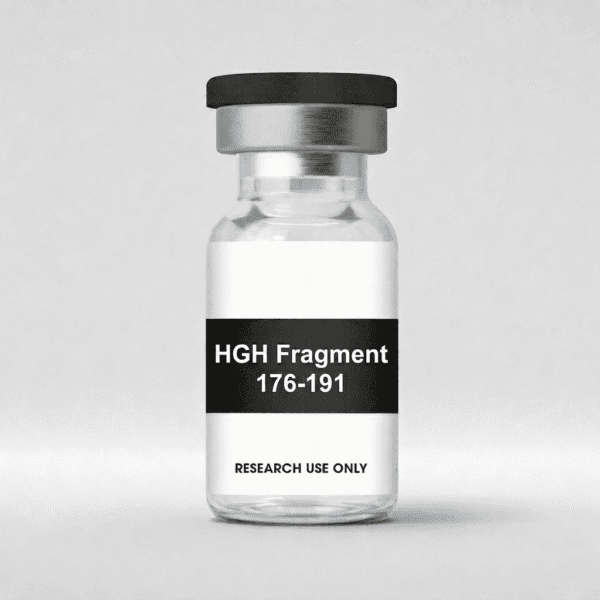
HGH Fragment 176-191
Price range: $51.00 through $146.00
HGH Fragment 176-191: Comprehensive Research, Mechanism and Scientific Overview
What Is HGH Fragment 176-191?
A short peptide sequence called HGH Fragment 176-191 is taken from the human growth hormone (HGH) C-terminal region. In order to determine whether certain sequences of the 191 amino acids that make up human growth hormone have biological actions different from those of the entire hormone, researchers have examined particular segments of the molecule.
Human growth hormone’s C-terminal sequences have been studied in relation to lipid metabolism, glucose regulation, and other biological processes, which has drawn attention to HGH Fragment 176-191.
Crucially, results from studies utilizing HGH or other growth-hormone fragments shouldn’t be used as proof that HGH Fragment 176-191 has the same effects on people.
The Science Behind HGH Fragment 176-191
Growth, metabolism, protein synthesis, and the control of energy availability are only a few of the physiological functions of human growth hormone, a peptide hormone.
To identify which amino acid sequences may contribute to specific biological actions, researchers have examined several sections of HGH.
HGH Fragment 176–191 is located in the hormone’s C-terminal region. Synthetic C-terminal HGH segments, such as sequences 176-191, 177-191, and similar peptides, were the subject of earlier experimental investigations. These investigations highlighted the significance of peptide structure and sequencing by showing that distinct segments could elicit distinct biological reactions.
HGH Fragment 176-191 and Lipid Metabolism Research
The connection between C-terminal HGH fragments and lipid metabolism is one of the main reasons they have garnered scientific attention.
The biological process known as lipolysis releases fatty acids that can be utilized as an energy source by breaking down stored triglycerides.
Growth hormone can promote lipolysis thru intricate signaling pathways involving adipose tissue, according to studies on the hormone’s wider impacts. Pathways involving proteins including FSP27, PPARγ, MEK/ERK, and STAT5 have been discovered in studies.
The possible antilipogenic action of C-terminal HGH sequences has been investigated in independent experimental studies. For instance, action linked to suppression of lipid formation in experimental systems was described in a study with synthetic HGH 177-191.
These findings provide scientific context for continued investigation of HGH-derived fragments, but they do not establish HGH Fragment 176-191 as a proven human weight-management treatment.
Potential Mechanisms Under Investigation
The precise mechanism of HGH Fragment 176-191 has not been completely established.
Research into C-terminal HGH fragments suggests that portions of the hormone may have biological actions that are not identical to those of the complete HGH molecule.
Areas researchers investigate include:
- Lipid metabolism
- Lipolytic signaling
- Glucose metabolism
- Insulin-related pathways
- Adipose-tissue biology
- Cellular signaling
- Structure-function relationships
Because these mechanisms can vary between experimental models, claims about a specific mechanism should be supported by research directly examining the 176-191 sequence.
HGH Fragment 176-191 and Fat Metabolism Research
One of the most often addressed topics related to HGH-derived fragments is fat metabolism.
Lipid mobilization and growth hormone are known to be related. For instance, greater GH secretion during fasting is linked to enhanced lipolysis and energy mobilization.
As a result, scientists have looked at the possibility that certain HGH components may be involved in some of these metabolic processes.
It is crucial to distinguish between HGH Fragment 176-191 study and full-length HGH research.
HGH Fragment 176-191 and Glucose Research
The relationship between glucose metabolism and C-terminal HGH fragments has also been investigated.
Several synthetic C-terminal HGH fragments, such as HGH 176-191, were shown in early experimental studies to cause more prolonged rises in plasma insulin and transient increases in blood glucose in rats.
Changes in glucose metabolism were found in other experimental studies that looked at C-terminal HGH sequences in isolated pancreatic islets.
These results show that while talking about HGH-derived peptides, metabolic effects should be taken into account. Additionally, they show why it is incorrect to characterize experimental pieces as generally advantageous for body composition or metabolism.
HGH Fragment 176-191 vs. Full-Length HGH
Although HGH Fragment 176-191 comes from human growth hormone, it is not the same molecule as full-length HGH.
| Characteristic | HGH | HGH Fragment 176-191 |
|---|---|---|
| Structure | 191 amino acids | Short C-terminal sequence |
| Origin | Human growth hormone | Derived from HGH |
| Molecular size | Much larger | Smaller peptide |
| Biological activity | Broad physiological activity | Specific experimental activity |
| Research status | Extensive clinical research | Primarily experimental research |
The shorter peptide is studied partly because researchers want to understand which regions of HGH contribute to specific biological functions.
HGH Fragment 176-191 vs. HGH Fragment 177-191
Although they are not identical sequences, HGH Fragment 176-191 and HGH Fragment 177-191 are closely related.
A single amino acid variation may have an impact on the stability, biological activity, receptor interactions, and peptide structure.
Even nearly related peptide sequences can result in distinct experimental responses, according to research that has explicitly looked at both sequences and related C-terminal fragments.
Instead of treating all HGH fragments as interchangeable, product labels should specify the precise peptide sequence for appropriate scientific communication.
Research Applications of HGH Fragment 176-191
Research involving HGH Fragment 176-191 can be relevant to several areas of peptide and metabolic science.
Lipid Metabolism
Researchers investigate how C-terminal HGH sequences may influence lipid storage and mobilization.
Adipose Tissue Research
HGH and related sequences are studied in adipocytes to better understand signaling pathways associated with lipolysis and lipid accumulation.
Glucose Metabolism
Experimental studies have examined how HGH-derived fragments interact with glucose and insulin-related processes.
Peptide Structure-Function Research
Short fragments provide researchers with a way to examine which regions of a larger protein contribute to particular biological effects.
Metabolic Signaling
Researchers can use peptide fragments to investigate cellular pathways involved in energy metabolism and hormone signaling.
Why Peptide Sequence Matters
Peptides are highly dependent on their amino-acid sequence.
Changing, removing, or adding even a single amino acid can potentially alter:
- Molecular structure
- Stability
- Solubility
- Binding characteristics
- Biological activity
- Metabolic breakdown
- Interaction with cellular targets
This is particularly important when comparing HGH Fragment 176-191 with related sequences such as HGH Fragment 177-191.
Current Scientific Evidence
HGH-derived fragments have a long research history dating back several decades. Synthetic C-terminal sequences have been studied experimentally for impacts on cellular functions, insulin, glucose, and lipid metabolism.
HGH Fragment 176-191 has also been studied in more recent studies in experimental biomedical uses. For instance, a 2022 study looked into the peptide in breast cancer cell models along with chitosan nanoparticles loaded with doxorubicin. It should not be taken as proof that the peptide is a proven cancer treatment because this was an experimental drug-delivery trial.
Overall, the data does not support HGH Fragment 176-191 as a proven treatment for obesity, disease, or other medical disorders, but it does warrant further scientific research.
Safety and Research Limitations
HGH Fragment 176-191 should be described as an experimental research peptide rather than an established therapeutic.
Important questions remain regarding its:
- Long-term safety
- Human pharmacokinetics
- Appropriate clinical use
- Biological half-life
- Metabolism
- Potential adverse effects
- Interactions with medications
- Reproducibility across different experimental models
Another consideration is product quality. Research peptides can vary in purity and identity depending on their source. Analytical characterization such as HPLC and mass spectrometry can help verify peptide identity and purity.
Frequently Asked Questions
What is HGH Fragment 176-191?
HGH Fragment 176-191 is a short peptide sequence derived from the C-terminal region of human growth hormone. It is studied experimentally for its potential biological and metabolic activities.
Is HGH Fragment 176-191 the same as HGH?
No. HGH is a 191-amino-acid hormone, whereas HGH Fragment 176-191 is a much shorter sequence derived from its C-terminal region.
What is HGH Fragment 176-191 researched for?
Research has investigated C-terminal HGH fragments in areas including lipid metabolism, glucose regulation, insulin-related responses, and cellular biology.
Does HGH Fragment 176-191 increase growth hormone?
It should not be described simply as a growth-hormone-releasing peptide. It is a fragment derived from HGH, rather than a conventional GH secretagogue.
Is HGH Fragment 176-191 clinically approved?
HGH Fragment 176-191 should not be presented as an approved treatment or as having established clinical efficacy.
Is HGH Fragment 176-191 the same as Fragment 177-191?
No. They are closely related sequences but differ by one amino acid. Experimental research has examined both peptides separately.
Why is HGH Fragment 176-191 studied?
Researchers are interested in understanding whether specific regions of human growth hormone contribute to biological effects involving metabolism and cellular signaling.
Is HGH Fragment 176-191 available in bulk quantities?
Yes. We provide scalable manufacturing with volume-based pricing.
Do you provide Certificates of Analysis?
Yes. Each batch includes verifiable COA documentation.
Do you ship within the USA?
Yes. Orders are fulfilled through our U.S. distribution channel.
What purity level is provided?
≥98% purity verified via HPLC (custom specifications available upon request).
HGH Fragment 176-191 Peptide for Sale – High Purity Research Compound USA
To guaranty purity, consistency, and trustworthy study results, you must source HGH Fragment 176-191 peptide for sale from a reputable producer. We provide top-notch research compounds for studies on growth hormone pathways, metabolism, and adipose tissue signaling.
We follow regulated laboratory standards in our operations.
Purity is confirmed by analytical testing.
Every production batch has complete documentation from us.
A synthetic peptide known as HGH Fragment 176-191 represents the amino acids 176 to 191 of the human growth hormone (HGH) molecule. It is frequently used in studies on energy management, adipocyte signaling, lipid metabolism, and biological pathways generated from growth hormone. Because of its peculiar structure, it is a useful molecule for studying particular mechanisms related to the function of growth hormone fragments.
Key Benefits
- Growth Hormone Fragment Research – Supports studies involving HGH-derived peptide signaling pathways
- Metabolic Pathway Analysis – Applicable in cellular energy regulation and metabolic function research
- Adipose Tissue Studies – Useful for investigating fat cell signaling and regulatory mechanisms
- Peptide-Receptor Interaction Research – Ideal for examining biological responses to HGH-derived fragments
- Advanced Peptide Profile – Designed for consistency and reproducibility in laboratory environments
What You Receive
- ≥98% purity (HPLC verified)
- Analytical validation (HPLC + Mass Spectrometry)
- Certificate of Analysis (COA) available per batch
- Laboratory-secured packaging
- Available in small batch or bulk wholesale quantities
Direct manufacturer sourcing ensures product integrity, traceability, and consistent long-term supply.
Bulk HGH Fragment 176-191 Supply
We support:
- Biotechnology research laboratories
- Pharmaceutical R&D organizations
- Academic research institutions
- Contract research organizations (CROs)
- Metabolic and endocrine research centers
- International distributors
Why Professional Buyers Choose Us
- Transparent manufacturing processes
- Verified analytical testing
- Consistent batch-to-batch quality
- Competitive wholesale pricing
- Reliable U.S. and international fulfillment
We combine advanced peptide synthesis capabilities with a global distribution network, ensuring dependable research-grade supply for scientific and pharmaceutical research applications.
Conclusion
HGH Fragment 176-191 is an experimentally studied peptide derived from the C-terminal region of human growth hormone. Its scientific interest comes from research examining how specific HGH sequences may influence metabolic and cellular processes.
Research into related C-terminal HGH fragments has explored lipid metabolism, glucose regulation, insulin responses, and other biological pathways. However, experimental findings should be interpreted carefully, particularly when studies involve animals, isolated cells, or related but different peptide sequences.
For a scientifically responsible website, HGH Fragment 176-191 is best presented as a research compound with an interesting experimental history, rather than as a proven medical treatment.
| Dosage | 1mg*10vials, 2mg*10vials, 5mg*10vials, 10mg*10vials, 12mg*10vials, 15mg*10vials |
|---|
Related products
-

Retatrutide
Price range: $65.00 through $259.00Select options This product has multiple variants. The options may be chosen on the product page -
L-Carnitine
Price range: $52.00 through $63.00Select options This product has multiple variants. The options may be chosen on the product page -
GHRP-6 Peptide
Price range: $52.00 through $58.00Select options This product has multiple variants. The options may be chosen on the product page -
Hexarelin Acetate Peptide
Price range: $58.00 through $89.00Select options This product has multiple variants. The options may be chosen on the product page

Reviews
There are no reviews yet.